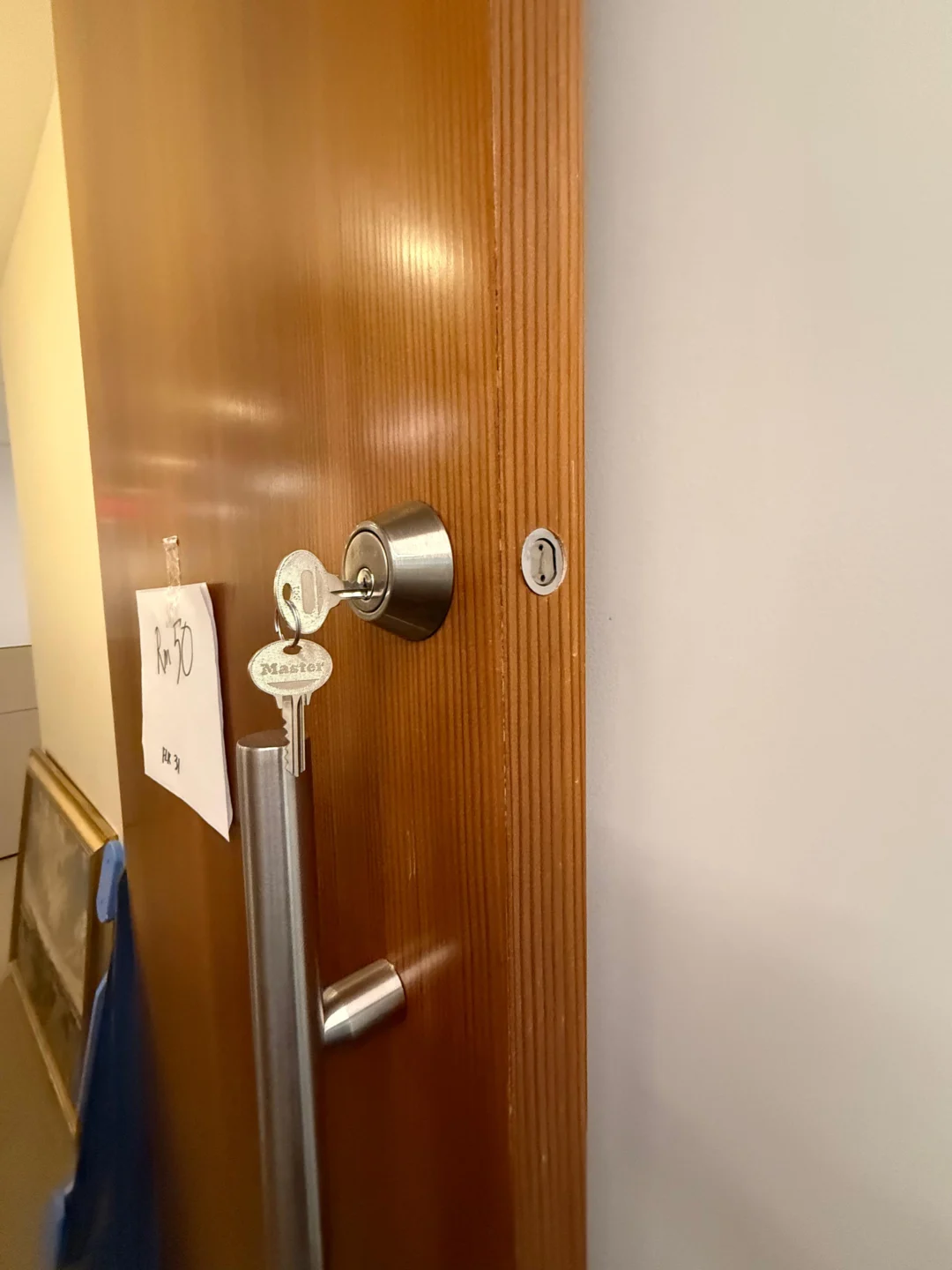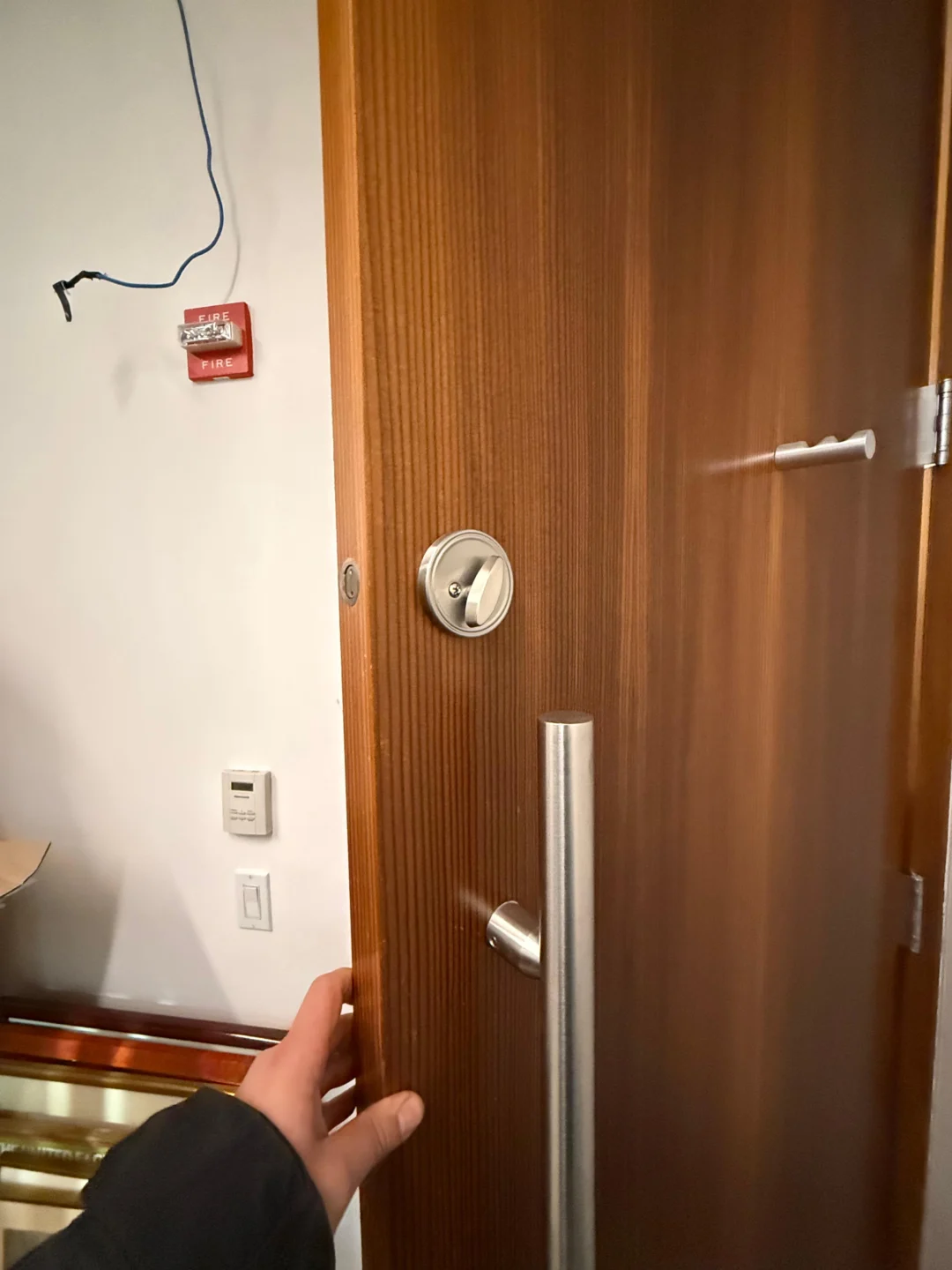
A door that closes but immediately swings back open usually does not have a “lock problem” in the general sense. More often, the spring latch is failing to enter and hold inside the strike plate. That can happen because the door has sagged slightly, the strike moved, hinge screws loosened, the latch is sticking inside the door, the door is being held away from the jamb by weatherstripping, or the latch mechanism itself is worn.
Schlage’s current troubleshooting guidance identifies three major causes when a latch does not operate properly: strike-plate misalignment, loose door hardware, and a worn latch or knob/lever assembly. That makes the correct troubleshooting order: check the latch, check the hinges, find where the latch hits, correct alignment, and replace hardware only if the mechanism itself is failing. Do not immediately enlarge the strike hole or move the strike plate. The location of the strike may be the symptom rather than the cause. Rainbow Locksmith NY’s residential services currently include lock repair and replacement, along with door hardware work for NYC homes.
First test the spring latch with the door open. If it retracts and extends normally, close the door slowly and identify where the latch hits the strike plate. Check loose or sagging hinges before moving the strike. If the door is correctly aligned but the latch barely misses the opening, make a small strike adjustment or reposition the strike as needed. If the latch sticks or fails to extend even with the door open, repair or replace the latch mechanism instead. The finished door should close and latch without being lifted, pushed, pulled, or slammed.
Quick diagnosis: why isn’t your door latching?
Start by matching the symptom.
| Symptom | Most likely area to check |
|---|---|
| Latch hits below strike opening | Door may have sagged |
| Latch hits above strike opening | Hinge/frame/strike position |
| Latch hits outer edge of strike | Door not closing deeply enough |
| Latch enters strike but door rattles | Strike tab or door-stop position |
| Latch works open but not closed | Alignment problem |
| Latch stays inside door | Latch mechanism or handle |
| Latch comes out slowly | Dirt, wear, internal spring |
| Must lift door to latch | Sagging door/hinges |
| Must push door hard to latch | Weatherstripping/stop/strike position |
| Must slam the door | Misalignment or sticking latch |
| Door used to latch but gradually stopped | Hinges, settling, wear |
| New lock never latched correctly | Installation or strike position |
The important distinction is whether the latch itself works when the door is open.
First understand what the spring latch does
A spring latch is the angled bolt that projects from the edge of many knob and lever locksets. When the door closes, the beveled side contacts the strike plate and is pushed temporarily into the door. Once the latch reaches the strike opening, its internal spring pushes it back outward. That outward movement is the click you hear when the door catches. This Old House describes the latch bolt as the spring-operated part of a lockset that enters the strike plate and keeps the door shut. If the latch never reaches the opening, the door will not stay closed. If the latch reaches the opening but does not extend, the latch mechanism may be faulty. Those require different repairs.
Spring latch vs. deadbolt: do not diagnose them as the same thing
A spring latch automatically retracts when its beveled face contacts the strike. A deadbolt does not. A door can therefore have a perfectly aligned deadbolt but a spring latch that misses its strike, or the opposite. If your symptom is simply that the door will not stay closed unless the deadbolt is locked, focus on the spring latch and lower strike, not automatically on the deadbolt above it. Kwikset even notes in its current smart-lock troubleshooting that a misaligned lower knob/lever latch can place extra load on an upper deadbolt, demonstrating that the two alignment systems can affect each other.
Step 1: test the latch with the door open
Keep the door open. Turn the knob or lever and watch the latch. It should retract into the door. Release the handle. It should extend fully again. Repeat this several times.
The latch snaps out normally
The spring mechanism is probably capable of doing its job. Your next focus should be alignment between the latch and strike.
The latch comes out slowly
The mechanism may be dirty, worn, or binding. Inspect the hardware before moving the strike plate.
The latch stays inside the door
That is primarily a latch or handle-mechanism problem. Schlage’s current troubleshooting says worn latch or knob/lever components can prevent normal latch retraction and operation. A strike adjustment will not repair a latch that cannot extend on its own.
The handle feels loose or floppy
Check the lockset’s mounting screws and handle mechanism. Loose door hardware is another condition Schlage specifically identifies when diagnosing a malfunctioning latch.
Step 2: close the door slowly and watch the latch meet the strike
Do not slam it. Stand where you can see the latch-side gap if possible and close the door gradually. Listen and feel for the exact moment the latch touches the strike plate. Ask: is it hitting above the opening? Below it? On the outer edge? Does it enter but fail to extend? That point of contact determines what needs attention.
Look for wear marks on the strike plate
The door often shows you exactly what is wrong. Inspect the metal strike for shiny scrape marks, chipped finish, scratches above or below the opening, and wear along the front lip. Those marks identify where the latch has been contacting the strike instead of entering cleanly. This Old House similarly recommends closing the door slowly and checking where the latch hits when diagnosing strike misalignment. Do not erase those marks until the door is fixed. They are useful evidence.
Use a marking test when the contact point is hard to see
A simple transfer-mark test can show where the latch lands against the jamb. This Old House currently recommends using a visible marking substance on the latch or bolt so its contact point transfers to the jamb or strike when the door is closed. The goal is not to coat the whole lock. You only need enough removable marking material to show whether the contact is too high, too low, too far inward, or too far outward. Once you know the direction of the error, diagnose why the door moved before modifying the strike.
Latch hitting the bottom of the strike
This is one of the most common patterns. If the latch is now lower than the strike opening, the latch side of the door may have dropped. That often points toward door sag. Possible causes include loose top-hinge screws, worn hinges, stripped hinge holes, and frame movement. Schlage specifically identifies worn or loose hinges and door sag as causes of latch or bolt alignment problems. This Old House likewise identifies loose hinges and settling as common causes of lock/strike misalignment. Before lowering the strike plate, inspect the hinges.
A simple test for a sagging door
Look at the gap between the top of the door and the frame. Then compare the hinge-side gap and the latch-side gap. An uneven reveal can indicate that the door is no longer square in the opening. Also check whether the door rubs at the upper latch-side corner, feels slightly heavier when closing, or latches if you lift the handle. If lifting the door causes the latch to catch instantly, hinge and door position is a strong suspect. Do not make lifting the door part of the daily closing routine. Fix why the door has dropped.
Tighten loose hinge screws first
Before moving the strike, inspect the hinges with the door open. Check the screws attaching the hinge to the door and the hinge to the jamb. If clearly loose, tighten them appropriately. Then close the door and retest. A small hinge movement can shift the latch enough to restore alignment without changing the strike plate at all. This is why moving the strike first can be the wrong repair: you may simply be moving the strike to follow a door that is still sagging.
What if the hinge screw just spins?
A screw that turns without tightening is not holding the hinge securely. That condition should be repaired before adjusting the latch strike because the door position is not stable. Repair methods depend on the frame material, screw-hole condition, and door construction. Avoid installing an arbitrary long screw without knowing what lies behind the jamb. The repaired hinge should hold the door consistently before final strike alignment is set.
Latch hitting the top of the strike
If the latch sits above the strike opening, inspect the complete door position rather than automatically raising the strike. Possible causes include a previous strike installed too low, door or frame adjustment, hinge shimming, a replacement lock installed at a slightly different height, and frame movement. The same principle applies: make sure the door is where it belongs before moving the strike to meet it.
Latch hits the front edge of the strike
This symptom means the latch may be vertically aligned but the door is not closing deeply enough for the latch to reach the opening. Possible causes include weatherstripping, the door stop position, a warped door, thick paint, a strike positioned too far toward one side, or a latch projection problem. Try closing the door using normal pressure. Do not push hard. If pushing the door against the stop makes the latch click, something is holding the door away from its correct closed position.
Check the weatherstripping
Weatherstripping can create more pressure than people realize. New or swollen weather seals can push the door away from the frame. Kwikset’s current door-alignment guidance specifically tells users to check whether weatherstripping is interfering with door alignment when a lock works open but binds after the door is closed. Look for newly replaced weatherstripping, compressed sections, seals folded over themselves, and unusually heavy resistance during the final inch of closing. Do not remove necessary weather sealing automatically. Determine whether it has been installed or positioned incorrectly.
The door closes, but you have to push it before the latch clicks
This is another alignment clue. If gentle additional pressure makes the latch catch, the strike may be positioned too far from the door’s natural resting position – or the door may be held outward by the stop or weatherstripping. A properly adjusted entrance should latch during its normal closing motion. It should not require someone to lean on it every time.
Door only stays closed if you slam it
Slamming is not a repair. If added speed is the only reason the latch reaches the strike, diagnose strike alignment, latch spring action, door position, and closer adjustment where applicable. This Old House notes that a door requiring a slam to stay closed is often experiencing a correctable strike-plate problem. Repeated slamming can also increase wear on the hinges, latch, strike, frame, closer, and lockset. Fix the cause instead.
The latch enters the strike but the door still rattles
This is different from a latch that misses completely. If the latch engages but the closed door has noticeable movement, the strike may not be holding the latch tightly enough against the door stop. Many standard strikes have a small adjustment tab inside or near the opening. This Old House describes adjusting this tab slightly to reduce movement when a door latches but rattles in its frame. Make small adjustments. You want the door snug enough to remain stable without creating excessive pressure that makes the handle difficult to operate.
Step 3: check whether the strike plate is loose
Before repositioning anything, put a screwdriver on the strike screws. A strike that can move on the jamb can produce inconsistent latching. You may notice the latch works sometimes, the strike shifts after the door slams, screws protrude, or the plate rocks against the jamb. Tighten clearly loose hardware. Then retest. Schlage specifically includes loose hardware among basic latch-failure checks. If the screws no longer hold, repair the underlying screw-hole and jamb condition rather than repeatedly tightening a loose screw.
Step 4: decide whether the strike actually needs to move
Only after confirming that the latch works, the hardware is secure, the hinges are stable, and the door position is correct should you decide whether strike adjustment is necessary. There are three levels of strike correction: minor interference (the latch barely touches one edge), a small positional error (the strike can potentially be shifted slightly), and major misalignment (the strike location needs to move enough that the existing screw holes or mortise no longer work). Do not use the same repair for all three.
Minor latch rubbing on the strike
If the latch is only touching the edge by a very small amount and the door itself is correctly aligned, a small amount of strike-opening adjustment may be sufficient. This Old House describes gradually filing the strike opening in the direction required and testing repeatedly rather than removing excessive material at once. The keyword is gradually. Do not turn a small strike opening into a large irregular hole. The latch should still be captured securely when the door closes.
When to reposition the strike plate
Moving the complete strike is more appropriate when the latch misses the opening by more than a minor amount and the door itself is correctly positioned. A typical repositioning process involves:
- Mark the latch’s true resting location.
- Remove the strike.
- Determine the corrected position.
- Prepare the jamb/mortise only as much as necessary.
- Establish secure screw locations.
- Reinstall the strike.
- Test repeatedly.
This Old House recommends repositioning the strike when filing is insufficient, including repairing old screw locations before drilling new pilot holes. Do not place the new screws partially into damaged old holes. The strike needs secure attachment.
Do not move the strike just because it is easier than fixing the door
Suppose your door has dropped because the top hinge is loose. You lower the strike. The door latches again. A month later the hinge moves farther. Now it misses the newly lowered strike. That is why the repair sequence matters. Stable door position comes before final strike placement.
Step 5: check the spring latch itself
Alignment is common, but not every latch problem is the frame. With the door open, push the latch inward and release it. It should extend fully. Operate the handle repeatedly. Watch for sluggish movement, inconsistent extension, the latch sticking halfway, the latch not retracting completely, grinding, and weak return. A worn latch or knob/lever is one of Schlage’s specifically documented causes of latch failure. If the latch cannot reliably extend into empty air, moving the strike will not fix it.
Latch stays retracted after you release the handle
This is a strong mechanical-failure symptom. The latch should normally return outward under spring force. Possible causes include a failed spring, a worn latch assembly, a binding chassis, or a handle mechanism problem. If the lockset is serviceable and a compatible latch replacement is available, the latch may be replaced separately. Otherwise, full knob/lever lockset replacement may be more practical. Rainbow Locksmith NY’s lock-replacement service covers worn and damaged residential lock hardware.
Latch only comes halfway out
A partially extended latch may fail to enter deeply enough into the strike to hold the door. Test whether it consistently reaches the same incomplete position. If so, the issue is mechanical. Do not reposition the strike farther toward the door simply to catch a latch that is no longer extending properly. Restore the latch first.
Door handle must be turned to close the door
Normally, the angled face of a spring latch should allow the strike to push it into the door automatically as the door closes. If you have to turn the knob or lever every time to retract the latch manually before shutting the door, something is wrong. Schlage’s current support article specifically addresses this symptom and identifies a misaligned strike, loose hardware, and worn latch or handle components. Start by looking at whether the angled face of the latch actually meets the strike correctly.
Check the latch orientation after a new installation
A new latch installed incorrectly may not interact correctly with the strike. The beveled face needs to be oriented according to the lock manufacturer’s installation design so the closing door can retract it smoothly. If the problem began immediately after installing a new knob, lever, or latch, revisit the latch orientation, backset, handle alignment, and strike position. Do not modify the frame until you are sure the lock itself was installed correctly.
New door handle installed but old strike no longer works
Replacement locksets do not always interact with an old strike exactly the same way. Even a small difference in latch shape, projection, backset, or trim position can expose an alignment issue. Use the strike specified or supplied for the new lock where the manufacturer requires it. Schlage’s current lock-alignment guidance recommends using the strike supplied with its hardware where the existing strike is preventing correct bolt operation.
Door latch suddenly stopped catching
When a door worked correctly for years and suddenly stops latching, ask what changed. Did the door begin rubbing? Check the hinges. Was weatherstripping replaced? Check compression. Was the lock replaced? Check hardware installation. Did the building or frame move? Check gaps and strike position. Did the handle become loose? Check mounting and latch operation. Did the latch become sluggish? Check the latch mechanism. The timing can save you from repairing the wrong component.
Door latch stops catching in certain seasons
Wood doors and frames can change with humidity and temperature. This Old House notes that environmental changes can contribute to door and lock misalignment. If the door latches in one season but binds in another, inspect the clearance around the slab, swelling, weatherstripping, and frame condition. Avoid making a large permanent strike modification to correct a temporary seasonal condition without understanding the door fit.
The latch hits the strike after the door was painted
Paint buildup can reduce clearances around the door edge, jamb, stop, strike mortise, and latch face. If a door stopped latching immediately after painting, inspect whether the coating has changed how deeply the door closes. Do not start cutting the jamb before checking for excess material or incorrectly seated hardware.
The door latch is catching, but the deadbolt is now hard to turn
This can happen when the spring latch holds the door in a position that is not ideal for the deadbolt. Kwikset specifically notes that lower latch/strike misalignment can put too much load on an upper deadbolt and recommends correcting the lower strike when the door must be pushed, pulled, or lifted to close properly. So when a door has both a spring latch and deadbolt, test the complete door system after every alignment repair. The goal is: the latch catches naturally, the deadbolt operates smoothly, and the door does not need repositioning by hand.
What if a door closer is installed?
On an apartment or commercial door, the closer adds another component to the diagnosis. The closer should bring the door far enough through its closing cycle for the latch to engage. If the door stops just before latching, possible problems include latch/strike misalignment, insufficient closing force, closer adjustment, door binding, and worn hinges. Do not immediately make the closer slam the door harder. A properly aligned latch should not require excessive impact. Rainbow Locksmith NY’s door-closer service covers closer installation, repair, and replacement on residential and commercial NYC doors.
NYC apartment entrance doors: the latch matters for fire safety
For many NYC apartment and hallway doors, a latch that does not catch is not simply an inconvenience. HPD states that required apartment and hallway self-closing doors must swing closed and latch by themselves. HPD’s November 24, 2025 self-closing-door guidance specifically tells owners and tenants to confirm that the latch engages when the door swings shut. It also identifies defective latches, hinges, closers, and frames as conditions requiring prompt repair. For applicable self-closing doors, an HPD inspector can issue a Class C immediately hazardous violation when a defect prevents proper self-closing, sealing, or latching. So an NYC apartment entrance that closes but does not click and remain latched should not be ignored.
Do not tape or disable the latch on an NYC self-closing door
A sticking latch can tempt occupants to tape it back so the door is easier to use. Do not do that on a required self-closing entrance. HPD explicitly tells tenants not to tamper with self-closing doors by taping the latch or otherwise defeating closing hardware. Repair the defect instead.
How to test an NYC self-closing apartment door after latch repair
HPD provides a very useful functional test. Open the door fully. Release it. The door should:
- Swing fully shut.
- Close completely.
- Allow the latch to engage.
- Remain closed without being manually pulled shut.
HPD also recommends checking for loose or missing hinges and conditions that obstruct closing. This is the correct final test for an applicable apartment or hallway door – not simply turning the knob with the door open.
Strike plate vs. latch replacement: which one do you need?
Use the open-door test.
Replace or service the latch when
The latch sticks inside the door, does not spring out, retracts inconsistently, remains partially extended, or feels mechanically damaged.
Adjust the strike/door when
The latch works perfectly while open but misses the strike when closed, catches only when the door is lifted, catches only when the door is pushed, or leaves clear impact marks away from the strike opening.
Investigate both when
The latch is sluggish and the door is misaligned. Two problems can exist at once.
Should you file the strike plate?
Only for small, confirmed alignment errors. Filing can be appropriate when the door position is stable, the latch is healthy, the contact is minor, and only a small amount of clearance is required. This Old House recommends filing gradually and testing frequently rather than removing a large amount of metal at once. Do not file half the strike away to compensate for a badly sagging door.
Should you chisel the jamb?
Only when the strike genuinely needs repositioning or additional properly located clearance. A chisel is not the first diagnostic tool. Before removing wood, establish the correct door position, the exact latch location, and the final strike location. Wood removed from the jamb cannot simply be put back. Make the smallest necessary adjustment.
When the strike screw holes are stripped
If the strike has been moved or tightened repeatedly, screw holes may no longer hold properly. The solution is to restore secure fastening material before final installation. This Old House recommends repairing old screw locations when a strike must be repositioned rather than relying on loose previous holes. The strike should not shift under normal door use.
What if the door frame is cracked?
A latch-alignment guide is no longer enough when the surrounding jamb is structurally damaged. Inspect for long cracks, split wood around the strike, missing jamb material, prior forced-entry damage, and strike screws pulling through. A properly positioned strike mounted into damaged material may still be insecure. Door-frame repair or reinforcement may be required. Rainbow Locksmith NY’s residential services include complete door fitting and hardware integration in addition to locksmith work.
Do you need a reinforced strike plate?
Not every latch problem requires one. A reinforced strike is primarily a security and frame-strength improvement. It does not correct a sagging door, a failed latch, a wrong strike position, or a binding handle. Align the door first. Then decide whether the strike area also needs reinforcement – our guide on how to install a reinforced strike plate covers that upgrade in detail.
What if the latch is on a mortise lock?
Mortise locks combine their latch with a larger lock case inside the door. If a mortise latch does not spring out or retract correctly even with the door open, the failure may involve the latch spring, hub, spindle, or internal lock-case components. That is different from a simple tubular replacement latch. Do not assume a modern cylindrical latch-replacement procedure applies to an older mortise lock. Rainbow Locksmith NY specifically handles mortise-lock repair among its NYC residential work.
Interior bedroom or bathroom latch not catching
For an interior door, the same diagnostic principles apply: latch movement first, alignment second. If the privacy button works but the latch itself does not catch, the lock button may not be the real problem. Test with the door open. If the spring latch works normally, inspect the strike and hinges. If it stays retracted or the knob does not operate it properly, service or replace the interior latch or lockset. Our guide to a stuck interior door lock button covers those privacy-lock failures in detail.
Exterior entry door latch not catching
An exterior door deserves more attention because the spring latch helps keep the door closed before the deadbolt is engaged. A latch that does not catch can also affect weather sealing, smart-deadbolt alignment, self-closing operation, and normal security. Do not rely permanently on the deadbolt to hold a door closed because the latch is broken. Fix both functions.
Smart lock installed above a misaligned spring latch
This is a common situation. The smart deadbolt gets blamed for jamming, but the lower spring latch is holding the door in an incorrect position. Kwikset’s troubleshooting specifically acknowledges this interaction and recommends correcting lower latch/strike alignment when it creates load on the smart deadbolt. After adjusting the lower strike:
- Close the door normally.
- Confirm the spring latch catches.
- Do not push or pull the door.
- Operate the smart deadbolt.
- Confirm smooth motor movement.
The door hardware should work as a system.
Repair or replace the spring latch?
Repair or adjustment makes sense when the latch itself works smoothly, the strike is slightly misaligned, hinge screws are loose, the strike is loose, or the door position can be restored. Latch replacement makes sense when the spring no longer extends the latch, the latch sticks repeatedly, the mechanism is damaged, and a compatible replacement part is available. Complete lockset replacement makes sense when the latch and handle are both worn, the chassis is loose, multiple components fail, a replacement latch is unavailable, or the hardware is damaged or obsolete. Rainbow Locksmith NY’s lock-replacement service identifies worn and damaged locks as reasons to replace existing hardware.
Door latch alignment checklist
Before calling the repair finished, verify:
- The latch extends fully with the door open.
- The handle retracts the latch smoothly.
- The handle returns normally.
- The hinges are secure.
- The door hangs evenly.
- The strike does not move.
- The latch enters the strike opening centrally enough to operate smoothly.
- The door closes without being slammed.
- The door does not need to be lifted.
- The door does not need to be pushed or pulled.
- The latch clicks into place.
- The door remains closed.
- The deadbolt still operates smoothly where present.
For an applicable NYC self-closing apartment or hallway door, also confirm that the door closes and latches automatically after being released.
Common door-latch repair mistakes
Avoid:
- Moving the strike before checking hinges
- Slamming the door instead of repairing it
- Filing a large amount from the strike immediately
- Chiseling the jamb without marking the latch location
- Ignoring a sluggish latch
- Treating the spring latch and deadbolt as the same mechanism
- Tightening damaged screws indefinitely
- Moving the strike to follow a sagging door
- Replacing the lock when the door is actually misaligned
- Replacing the strike when the latch itself does not extend
- Increasing door-closer speed just to make the latch catch
- Taping back the latch on a required self-closing door
Most unsuccessful repairs come from correcting the contact point without correcting why that contact point moved.
Frequently asked questions
Why is my door latch not catching the strike plate?
The latch and strike may be misaligned because of loose hinges, door sag, frame movement, weatherstripping, or incorrect strike placement. The latch mechanism itself can also be worn or sticking. Schlage identifies strike misalignment, loose hardware, and worn latch/handle components as the primary areas to inspect.
Why does my door close but not stay shut?
The spring latch may not be entering the strike opening. Close the door slowly and look for where the latch contacts the strike. If the latch works normally with the door open, alignment is more likely than latch failure.
Why do I have to lift my door for the latch to catch?
The latch side of the door may have sagged, commonly because of loose or worn hinges. Schlage and This Old House both identify door sag and hinge problems as common causes of lock and strike misalignment.
Why do I have to push the door to make it latch?
The door may not be reaching its natural closed position because of weatherstripping, strike placement, the door stop, or frame alignment. Kwikset specifically recommends checking weatherstripping when diagnosing door alignment.
Why won’t the latch come back out?
If the spring latch remains retracted even with the door open, the latch or handle mechanism may be worn or damaged. Schlage identifies worn latch and knob/lever components as a cause of latch-retraction problems.
Why do I have to turn the knob to close the door?
A correctly functioning spring latch should retract against the strike as the door closes. Needing to turn the handle can indicate strike misalignment, loose hardware, or a worn latch – the same conditions identified in Schlage’s current troubleshooting guidance.
Should I move the strike plate?
Only after confirming that the hinges are secure, the door position is correct, and the latch itself works. If the door has sagged, correct that condition first.
Can I file the strike plate?
A small amount of filing can correct minor verified interference. This Old House recommends filing gradually and testing frequently rather than making a large opening.
Why does my door latch but rattle?
The latch may be entering the strike without holding the door tightly enough against the stop. Some strikes have an adjustable tab that can be modified slightly to tighten the fit.
Why does my latch work when the door is open but not closed?
That is strong evidence of a door/strike alignment problem. With the door open, the frame cannot put pressure on the latch. Compare the two conditions before replacing hardware.
Can loose hinges make a door stop latching?
Yes. Loose or worn hinges can allow the door to sag, changing the vertical position of the latch relative to the strike.
Can weatherstripping cause a latch problem?
Yes. Excessive or poorly positioned weatherstripping can keep a door from reaching its proper resting position. Kwikset includes weatherstripping in its current door-alignment troubleshooting.
Why did my smart lock start jamming when my lower door latch became misaligned?
A misaligned lower latch can hold the door in a position that puts additional load on the upper deadbolt. Kwikset specifically documents this interaction in its smart-lock troubleshooting.
Does an NYC apartment door have to latch automatically?
For required self-closing apartment and hallway doors, yes. NYC HPD states that these doors must swing closed and latch by themselves.
Can an NYC landlord ignore an apartment door that does not latch?
HPD states that defects preventing a required self-closing door from properly closing or latching can result in a Class C immediately hazardous violation and require prompt correction by the property owner.
When should I replace the latch?
Replace the latch when it no longer extends reliably, remains stuck even with the door open, or has clear mechanical wear or damage. If the handle or chassis is also failing, complete lockset replacement may be more practical.
When should I call a locksmith?
Professional repair makes sense when the latch remains mechanically jammed, the frame or strike area is damaged, mortise hardware is involved, a required self-closing apartment door will not latch, the entrance cannot be secured, or repeated adjustments do not solve the problem. Rainbow Locksmith NY currently offers residential lock repair and replacement services as well as residential-door and door-closer work throughout New York City.
Get help from Rainbow Locksmith NY
Door swinging back open, latch missing the strike, or a self-closing apartment door that will not latch? Rainbow Locksmith NY repairs latches, strikes, hinges, and closers across NYC – 24/7, with the price quoted before dispatch.
Rainbow Locksmith NY | 338 E 65th St, New York, NY 10065 | Licensed and insured | NYC DCWP License. Door and lock designs vary; follow your exact manufacturer’s guidance and make the smallest adjustment that restores reliable latching.