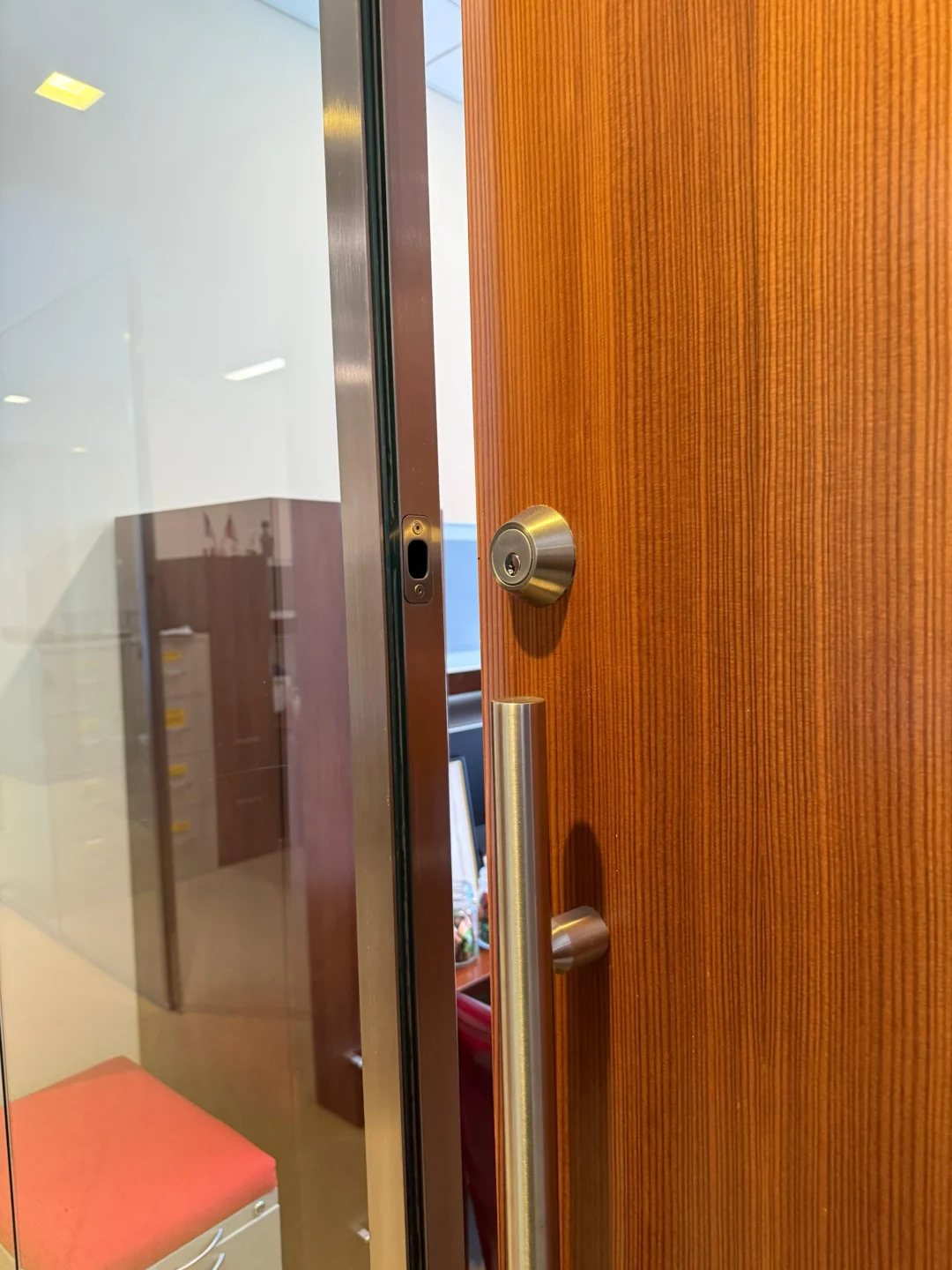
A reinforced strike plate can strengthen one of the most important connections in an entry-door locking system: the point where the latch or deadbolt enters the door frame. But installing one correctly is not as simple as replacing two short screws with the longest screws you can find.
Before changing the hardware, determine what problem the door actually has. A weak standard strike, a deadbolt that hits the edge of the opening, a sagging door, stripped screw holes, and a cracked jamb are different problems that require different repairs. This distinction is frequently lost in generic door-security advice. Schlage’s current deadbolt installation guidance treats the reinforcement plate as a separate component installed beneath the finished strike, and it instructs users to test the deadbolt both with the door open and closed so strike or jamb misalignment can be identified. Schlage also sells strike reinforcement with 3-inch screws for compatible installations, but specifically warns that those long screws may be inappropriate where a sidelight is located beside the lock side of the door.
That is why this guide focuses on diagnosis first and reinforcement second. If your door needs more than a strike upgrade, Rainbow Locksmith NY provides professional lock installation and related residential security work in New York City.
First test the deadbolt with the door open and closed to make sure the strike is correctly aligned. Remove the existing strike, inspect the jamb for cracks or stripped holes, and dry-fit the reinforcement before removing wood. Mortise only as much as needed for the plate to sit correctly, drill pilot holes when required by the hardware manufacturer, and install the specified fasteners evenly. After installation, test the deadbolt again with the door open and closed. The bolt should extend fully without scraping or requiring you to push or pull the door.
First: what problem are you trying to fix?
Before buying a reinforced strike plate, close and lock the door normally, and think about what you are actually experiencing.
The existing strike plate is small or light
If the door and deadbolt operate perfectly but the existing strike is a small standard plate with minimal frame attachment, reinforcing that area can be a sensible security upgrade. Some modern deadbolt systems already incorporate an underlying reinforcement plate – Schlage’s installation documentation, for example, shows an optional reinforcement plate secured to the frame with the finished strike mounted over it. In this situation, the job is mainly about strengthening an otherwise healthy installation.
The deadbolt scrapes the strike
That is primarily an alignment problem. Do not assume a reinforced strike will correct it. Schlage recommends operating the bolt first with the door open and then with it closed. If it moves freely when open but drags or hits the strike after the door closes, the strike or jamb needs alignment work. You need to identify the reason for the contact before permanently reinforcing the strike in the wrong position.
The strike screws no longer hold
Stripped holes indicate a mounting problem. A larger reinforcement plate may provide additional fastening locations, but badly damaged jamb material should be evaluated rather than simply covered with more metal.
The jamb is cracked
A reinforced plate cannot magically restore severely split wood. If a crack extends through the strike area, especially after a forced-entry attempt, the jamb itself may need repair or more extensive reinforcement. For sudden damage that leaves an entrance unable to lock reliably, Rainbow Locksmith NY’s emergency locksmith services are more relevant than treating the condition as a routine DIY hardware upgrade.
The entire lock is worn or damaged
A new strike cannot repair a failing deadbolt. If the cylinder, bolt, mounting hardware, or lock body is also damaged, consider whether lock replacement makes more sense than reinforcing the frame around an unreliable lock.
What does a reinforced strike plate actually do?
The strike plate is installed on the door jamb and provides the opening into which the latch or deadbolt travels. A reinforcement system strengthens the frame-side hardware around that opening. Depending on the product, reinforcement may use:
- Thicker steel
- More mounting points
- A longer plate design
- A separate reinforcement plate
- Longer structural fasteners
- A deeper strike box
- Combined latch-and-deadbolt openings
There is no single universal “reinforced strike plate” design. Schlage currently offers both integrated strike-and-reinforcer arrangements and separate reinforcement parts for several deadbolt families, and its 2026 residential hardware catalog lists dedicated 3-inch reinforcement screws for compatible systems. This is why you should select the hardware before cutting the jamb.
Reinforcement plate vs. security strike vs. jamb reinforcement
These terms are often used interchangeably online, but they can describe different levels of work.
Reinforcement plate behind the strike
Some deadbolts use a structural plate behind the visible decorative strike. Schlage’s current instructions show this configuration clearly: the reinforcement is attached first, and the finished strike is then installed over it. This is a relatively compact upgrade when the frame and lock alignment are already sound.
Extended security strike
An extended strike is taller than a conventional plate and uses additional mounting locations. Its larger footprint can distribute attachment across more of the jamb. These products may require additional mortising so the longer plate sits properly against the frame.
Full door-jamb reinforcement system
A jamb-reinforcement kit extends well beyond the small deadbolt strike area. This may make more sense where the objective is broader frame reinforcement rather than simply replacing a weak strike plate. Do not assume the most extensive system is automatically necessary – match the repair to the condition of the door.
Is your door suitable for DIY strike reinforcement?
A conventional wood residential jamb in good condition is the easiest candidate. DIY becomes less straightforward with:
- Hollow-metal frames
- Steel apartment entrances
- Fire-rated door assemblies
- Commercial storefront doors
- Historic frames
- Severely damaged jambs
- Doors with sidelights close to the strike
- Unusual wall construction behind the jamb
The fastening method needs to match the construction. A screw intended to reach wood framing is not automatically the right fastener for a hollow-metal door frame. For commercial or specialty installations, Rainbow Locksmith NY’s high-security lock systems service is a more relevant resource than applying a generic residential procedure.
The most important test before installation
Do this before removing the old strike.
Test the deadbolt with the door open
Open the door and extend the deadbolt. It should move through its complete travel without significant resistance. Operate it several times using the interior thumb turn and exterior key. If it already sticks while the door is open, the strike plate is not causing that problem – investigate the lock itself.
Test the deadbolt with the door closed
Now close the door normally and operate the deadbolt again, and compare the feel. If it suddenly becomes harder to turn, the bolt is probably contacting the strike or jamb. This open-versus-closed test is part of Schlage’s own current deadbolt installation procedure, which makes it one of the most useful diagnostic checks in the entire project.
Do not push or pull the door during this test
Use the door in its natural resting position. If the deadbolt only works when you push, pull, or lift the door, you already have an alignment issue. Possible causes include loose hinge screws, door sag, frame movement, weatherstripping pressure, or an incorrect strike position. Fixing those conditions is more important than making the strike opening larger.
How to choose the correct reinforced strike plate
Do not choose based only on which plate looks strongest. Measure and inspect the existing setup first.
Check whether you are reinforcing a latch or deadbolt
A latch strike and a deadbolt strike do different jobs. Some extended security strikes combine openings for both. If buying a combined plate, measure the vertical spacing between the latch and deadbolt carefully.
Measure the existing strike
Record:
- Plate height
- Plate width
- Screw-hole spacing
- Bolt-opening dimensions
- Mortise depth
- Distance between latch and deadbolt if applicable
Matching the existing preparation can dramatically reduce unnecessary wood removal.
Look at the bolt pocket
The metal plate is only the visible portion. The deadbolt also needs sufficient clear space behind the strike to extend fully. Do not install a stronger strike that prevents the deadbolt from reaching its full locked position.
Check the manufacturer’s fastener requirements
Use the fasteners specified for the actual security strike or reinforcement system. Kwikset’s current deadbolt installation instructions, for example, specifically require pilot holes when installing its strike and optional strike box. Manufacturer instructions should take priority over generic internet advice.
Longer strike screws are one of the most repeated recommendations in door-security articles, and there is a legitimate basis for the advice – Schlage offers strike reinforcement using 3-inch screws, and certain Kwikset deadbolt strike kits also include 3-inch fasteners. But 3 inches is not a universal rule for every door. The correct screw depends on the reinforcement design, manufacturer instructions, jamb thickness, the material behind the jamb, nearby glass, frame construction, and door type. Schlage specifically notes that 3-inch screws may be too long where a sidelight runs beside the latch side of the entry. Use the manufacturer-specified reinforcement fasteners after confirming what they will penetrate – not simply the longest screw available.
Tools for a typical wood-jamb installation
For a conventional residential wood frame, you may need:
- Phillips screwdriver
- Tape measure
- Pencil
- Drill
- Correct pilot drill bit
- Sharp wood chisel
- Hammer
- Utility knife
- Reinforced strike hardware
- Manufacturer-specified screws
Not every installation requires all of these tools. If the new plate already fits the existing mortise, there is no benefit to chiseling more wood simply because you have a chisel available.
Installing the reinforced strike plate
The following procedure is appropriate for a conventional compatible wood-frame installation. Specialty, metal, commercial, and fire-rated doors may require a different approach.
1. Record the existing alignment
Before removing the strike, photograph it – one photo of the strike itself and another showing the complete door closed in the frame. If the door currently locks smoothly, that existing bolt position is valuable information. Your objective is to strengthen the strike without accidentally changing good alignment.
2. Mark where the deadbolt naturally lands
Close the door without forcing it and observe where the bolt reaches the strike. If necessary, use a removable marking method to identify its position. Do not base the new plate position on where the bolt lands while you are pulling or pushing the door – the strike should meet the door in its natural closed position.
3. Remove the existing strike
Open the door and remove the old strike screws. If paint has sealed the edges of the plate to the jamb, score the paint carefully before lifting the strike away. Avoid aggressive prying that damages the finished frame, and keep the old hardware until the new installation is complete.
4. Inspect what was hidden behind the plate
Removing the strike often reveals problems that were not visible before. Check for split wood, enlarged screw holes, missing wood, several previous screw locations, excessive chiseling, moisture damage, loose filler, or an oversized bolt pocket. If the material is badly compromised, stop treating this as a simple strike replacement – the jamb may need repair first.
5. Dry-fit the reinforcement
Place the new reinforcement against the frame without drilling. Confirm that the bolt opening aligns, the plate sits at the correct height, the door can close, the plate does not interfere with trim, the existing mortise is adequate, and the screw locations make sense for the frame. This dry fit can prevent most avoidable installation mistakes.
6. Decide whether mortising is actually necessary
Some reinforced plates are larger or thicker than the original strike and need a larger recess. If so, trace the portion that needs to sit flush. Do not automatically recess the entire outline deeper than necessary. The objective is to allow the plate to sit properly against the jamb, not to remove as much wood as possible.
7. Remove wood gradually
On a suitable wood jamb, use a sharp chisel and remove thin layers, checking the fit repeatedly. A properly mortised plate should sit evenly without rocking. Avoid cutting beyond the plate outline, creating an unnecessarily deep cavity, splitting the edge of the jamb, or removing support around the screw locations. You can always remove another thin layer – replacing wood that has already been cut away is much harder.
8. Mark the fastener locations
Hold the reinforcement in its final position and mark each screw location. If the new security plate is much taller than the old one, confirm that the screw path does not conflict with an unexpected feature of the door assembly. This matters especially near sidelights and specialty frames.
9. Drill appropriate pilot holes
Use the pilot-hole diameter specified for the supplied fastener and frame material. Kwikset explicitly calls for pilot holes when installing the strike on its 816 deadbolt system. Pilot holes help guide the screw and can reduce unnecessary splitting in appropriate wood construction. If the drill unexpectedly reaches metal, masonry, wiring space, or another material you did not anticipate, stop and identify the construction before continuing.
10. Secure the reinforcement gradually
Start the fasteners without fully tightening one screw immediately, and work progressively across the plate. This helps keep the reinforcement in the position you established during the dry fit. With a two-part Schlage-style system, the underlying reinforcement is installed first and the finished strike follows. With an extended one-piece security strike, follow the sequence supplied with that product. Do not combine installation instructions from unrelated hardware.
11. Check that the plate stayed flat
After tightening, inspect the plate from several angles. It should not rock, bow, twist, pull away from the jamb, or sit proud enough to hit the door. Excessive torque can distort hardware or crush softer jamb material. Secure is the goal; maximum torque is not.
12. Test the door before declaring the job finished
First operate the deadbolt with the door open. Then close the door naturally and repeat the test. The bolt should enter the reinforced strike without requiring unusual pressure. Schlage instructs installers to adjust the strike or jamb when the bolt drags during closed-door operation.
Your deadbolt should not need help from your shoulder
A surprisingly useful test is whether you have to lean into the door before locking it. If you need to push the slab toward the frame, the reinforced strike is not naturally aligned. If you need to pull the door toward you, the same is true in the opposite direction. A properly positioned deadbolt strike should allow normal locking with the door resting where the hinges, stop, weatherstripping, and closer naturally place it. If you have developed a habit of physically repositioning the door every time you turn the key, reinforcement alone is not the correct repair.
Troubleshooting after reinforcement
The bolt hits the top of the strike
Before moving the plate, check whether the door has sagged. Inspect the hinge screws and compare the gaps around the slab. If the door has dropped, moving the strike downward may only follow a problem that will continue getting worse.
The bolt hits the bottom
The same principle applies. Check the complete door position rather than treating the strike as the only adjustable component.
The bolt hits the side of the opening
Determine whether the door is sitting too far toward or away from the stop. Weatherstripping can sometimes change how deeply the door rests in the frame. Do not grind away a large part of the new security strike before checking door position.
The key became harder to turn after installation
Test with the door open. If the lock is smooth open but difficult closed, you still have strike contact. If it is difficult even open, investigate the deadbolt itself rather than continuing to modify the reinforced strike.
The new plate shifted while tightening
Loosen the hardware enough to reposition it correctly – before enlarging the bolt opening. A small installation shift can create unnecessary rubbing.
The screws will not tighten
If the screws spin without becoming secure, the intended mounting material may already be damaged or the chosen fastener may not match the construction. Do not hide a weak mounting point by leaving the plate loosely attached. The support behind the strike is the reason reinforcement exists.
What if the jamb is already cracked?
A reinforcement plate can spread attachment across a larger area, but it should not be used as decorative cover over serious structural damage. A significant jamb crack may require wood repair, replacement of damaged jamb material, a larger reinforcement system, frame repair, or a complete door-system evaluation. If the crack resulted from a burglary or forced-entry attempt, also inspect the lock, bolt, hinges, and door edge – the visible strike damage may be only one part of the problem.
Reinforced strike plate vs. longer screws only
Replacing very short strike screws with appropriately specified longer screws can improve frame attachment in some installations. But that does not necessarily create the same system as a dedicated reinforced strike. A reinforced design can also provide thicker steel, a larger load-distribution area, more mounting locations, backing reinforcement, a different bolt pocket, and extended jamb coverage. Schlage’s own deadbolt hardware distinguishes the finished strike, reinforcement plate, and reinforcement screws as separate components in some configurations. So “add longer screws” and “install a reinforced strike” should not automatically be treated as identical upgrades.
Reinforced strike plate vs. full jamb reinforcement
A strike upgrade concentrates reinforcement around the latch or deadbolt. A jamb-reinforcement system addresses a larger portion of the lock side of the frame. Consider a broader system when multiple areas of the jamb are damaged, the existing strike area has been repaired repeatedly, both latch and deadbolt areas need support, a larger security upgrade is planned, and the door and frame construction supports the system. A small strike plate is often adequate when the existing frame is sound and the goal is simply improving the attachment of the deadbolt. Do not overcomplicate a healthy door.
What about smart locks?
A motorized deadbolt makes precise strike alignment even more important. A person using a mechanical lock can unconsciously push or pull the door while turning the thumb turn – a smart-lock motor cannot reliably compensate for that kind of misalignment. If you are planning a smart-lock upgrade, make sure the mechanical deadbolt enters the reinforced strike smoothly first. Our comparison of smart locks and deadbolts for NYC apartments discusses the physical-security role of a deadbolt alongside electronic access features, and we also offer smart lock installation and setup.
NYC apartment doors need extra caution
A DIY strike upgrade on a typical single-family wood jamb is not necessarily equivalent to changing hardware on an NYC apartment entrance. Apartment doors in New York City may be part of required fire- and smoke-containment systems, and HPD states that apartment and hallway doors covered by the city’s requirements must swing closed and latch automatically. A defect that prevents proper self-closing or latching can result in an immediately hazardous violation. That means any strike modification should preserve normal latching.
After completing work on an apartment entrance:
- Open the door fully.
- Release it normally.
- Confirm that it closes by itself where required.
- Confirm that the latch engages.
- Confirm that the new strike does not obstruct closure.
- Confirm that the deadbolt operates without forcing the door.
NYC Fire Code also requires door hardware and physical components of required means of egress to remain in good working order. If the apartment entrance uses a metal frame, specialty fire-door assembly, or unusual building hardware, do not assume ordinary wood-jamb chiseling and screw methods are appropriate.
Can you install a reinforced strike on a metal frame?
Yes in some systems, but not by copying the wood-jamb procedure above. Metal-frame strikes may rely on existing threaded preparation, machine screws, specialized commercial strike hardware, internal reinforcement, or other manufacturer-specific mounting methods. Driving a residential wood screw into hollow metal simply because it is long does not reproduce the intended fastening method. For office, retail, and other commercial entrances, Rainbow Locksmith NY’s commercial locksmith services and high-security lock systems are more relevant resources.
Does a reinforced strike make a cheap lock “high security”?
No. The strike is one component of a complete entrance. Door security also depends on the lock hardware, bolt, cylinder, door slab, jamb, frame, hinges, installation, and key control. A reinforced strike can improve the frame side without changing the security characteristics of the cylinder or deadbolt itself. If the objective is a broader security upgrade, compare the strike condition with the actual lock system instead of assuming one piece of hardware solves every weakness.
Common mistakes that reduce the value of the upgrade
The most common reinforced-strike mistakes are not complicated – they are usually failures to diagnose the door first. Avoid:
- Reinforcing a strike that is already misaligned
- Ignoring loose hinges
- Installing over seriously cracked wood
- Buying an extended plate without measuring
- Chiseling before dry-fitting
- Removing too much jamb material
- Automatically using 3-inch screws on every door
- Ignoring nearby sidelights
- Skipping pilot holes where the manufacturer requires them
- Using wood-door methods on metal frames
- Overtightening until the plate distorts
- Failing to test the door closed
- Interfering with an NYC apartment door’s normal latching
The strongest-looking hardware is not useful if the finished door becomes difficult to operate.
How to evaluate the finished installation
Do not judge the job only by how solid the new plate feels – evaluate the complete door. The finished reinforcement should meet these conditions:
- The strike sits securely against the frame.
- No significant jamb cracking was created.
- Screws are firmly seated.
- The door opens normally.
- The door closes normally.
- The latch engages properly.
- The deadbolt extends fully.
- The key operates smoothly.
- The thumb turn operates smoothly.
- The bolt does not scrape heavily.
- No pushing or pulling is required to lock.
- The self-closing function remains intact where required.
If all of those are true, the reinforcement is doing its job without creating another problem.
When to stop DIY and call a locksmith
A conventional wood-frame strike upgrade can be a manageable project when the door is already correctly aligned and the jamb is healthy. Professional evaluation becomes more sensible when:
- The jamb has a long structural crack
- Forced-entry damage is present
- The door has significant sag
- The existing strike was moved multiple times
- The door frame is metal
- The apartment door is specialty or fire-rated
- A sidelight makes fastener depth uncertain
- The construction behind the jamb is unclear
- The deadbolt repeatedly binds
- The lock itself is failing
- Several parts of the entrance need reinforcement
Rainbow Locksmith NY provides residential locksmith services, lock installation, lock replacement, and high-security lock systems for properties in New York City.
Frequently asked questions
What is a reinforced strike plate?
A reinforced strike plate is upgraded frame-side hardware designed to strengthen the area where a latch or deadbolt enters the jamb. Depending on the product, it may use heavier metal, a separate backing plate, additional screw locations, or longer reinforcement fasteners. Schlage currently uses both integrated and separate reinforcement configurations across its deadbolt hardware.
Is a reinforced strike plate worth installing?
It can be a worthwhile upgrade when the existing door and lock operate correctly but the frame-side strike is light, loose, or poorly supported. It is less useful as a substitute for repairing a severely cracked jamb or misaligned door.
Do I need 3-inch screws for a reinforced strike plate?
Not always. Some Schlage and Kwikset reinforcement systems use 3-inch screws, but fastener choice should follow the hardware manufacturer and actual frame construction. Schlage also warns that 3-inch screws may be too long beside some sidelights.
Should I drill pilot holes?
Follow the hardware manufacturer’s instructions. Kwikset’s current 816 deadbolt installation instructions specifically state that pilot holes are required for its strike screws.
Why does my deadbolt hit the reinforced strike?
The strike may have shifted during installation, or the door may already be misaligned. Test the deadbolt with the door open. If it works smoothly open but hits when closed, investigate strike and door alignment. Schlage uses this same diagnostic test in its installation procedure.
Should I move the strike if the door is sagging?
Correct obvious hinge or door-position problems first. Moving the strike to match a sagging door can hide the symptom while the underlying alignment problem continues.
Can a reinforced strike plate fix a cracked jamb?
Minor damage and major structural splitting should not be treated the same way. A reinforcement plate may provide additional attachment across healthy material, but substantial jamb damage can require actual frame repair.
Can I install a reinforced strike on a metal door frame?
Possibly, but metal frames use different strike preparations and fastening methods. Do not automatically use long residential wood screws in a hollow-metal frame.
Does a smart lock work with a reinforced strike plate?
Yes, provided the mechanical deadbolt is properly aligned. Motorized locks benefit from a bolt path that is smooth and free of binding.
Should I reinforce both the latch and deadbolt?
That depends on the existing door and the reinforcement product. Some extended security strikes cover both openings, while other systems are designed only for the deadbolt. Measure your hardware before choosing a combined plate.
How do I know if the strike is properly aligned?
The deadbolt should extend and retract smoothly with the door both open and closed. You should not need to push, pull, or lift the door before locking it.
Can I modify the strike on an NYC apartment door?
Use extra caution. NYC HPD requires applicable apartment and hallway doors to close and latch automatically, so strike work must not interfere with normal latching or self-closing operation.
Get help from Rainbow Locksmith NY
Want the frame side of your door done right? Rainbow Locksmith NY diagnoses alignment, repairs damaged jambs, and installs reinforced strikes and high-security hardware across New York City.
Rainbow Locksmith NY | 338 E 65th St, New York, NY 10065 | Licensed and insured | NYC DCWP License. Hardware designs and fastener requirements change; follow your exact manufacturer’s instructions and confirm frame construction before drilling.