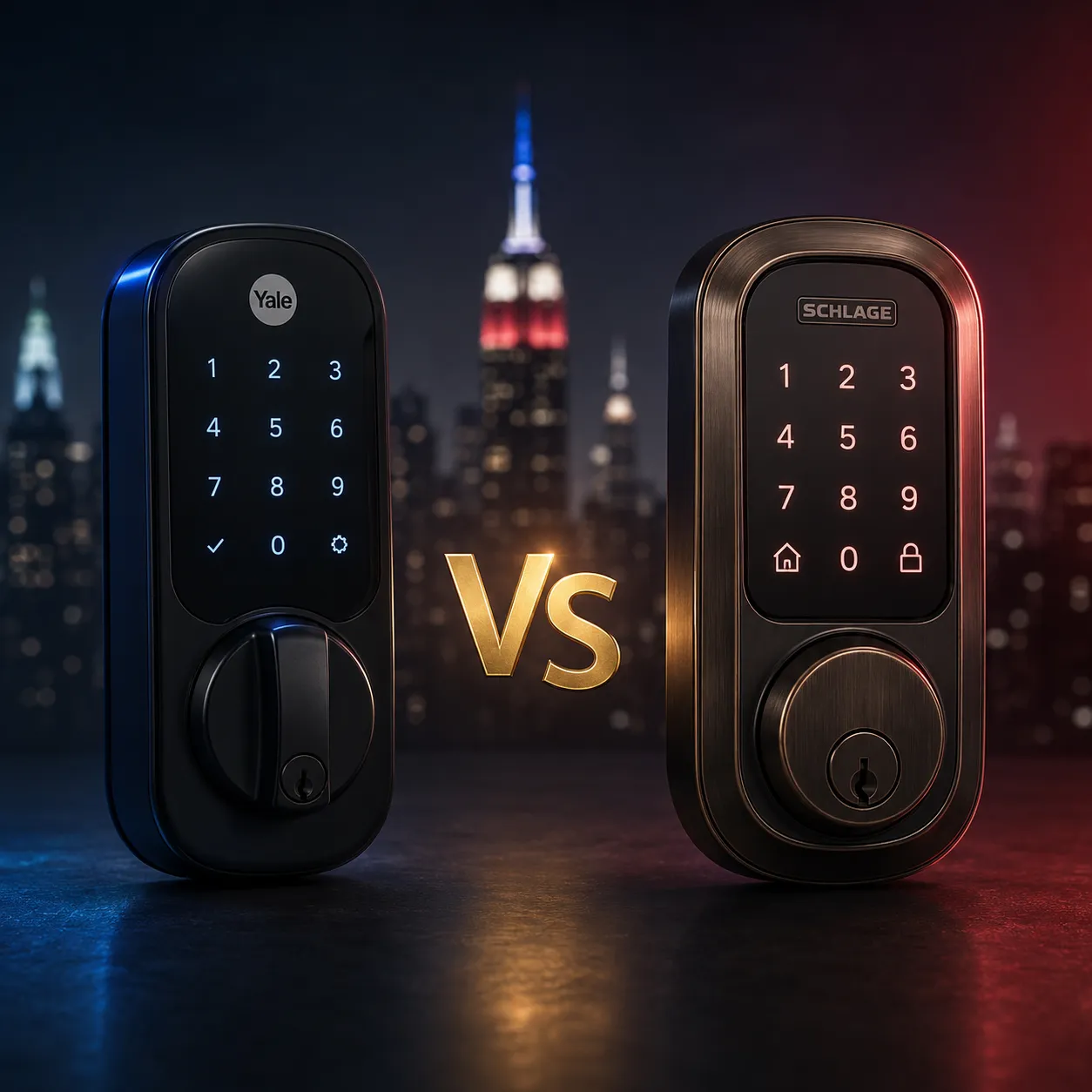
If you are shopping for a premium smart lock in 2026, the choice almost always comes down to two names. Yale Assure Lock 2 and Schlage Encode Plus dominate the top tier of the smart lock market, and for good reason. Both support Apple Home Key. Both have keypads. Both have built-in Wi-Fi options. Both come from manufacturers with over a century of locksmithing history.
But after installing both locks in dozens of NYC apartments and brownstones, we can tell you they are not the same lock with a different badge. The Yale Assure Lock 2 and Schlage Encode Plus serve genuinely different buyers, and picking the wrong one is the kind of mistake that costs you $300 plus the hassle of returning a lock you already mounted on your door.
This is our honest, hands-on comparison from a NYC locksmith perspective. No affiliate hype, no spec sheet regurgitation. Just the real differences that matter when this lock is on your apartment door for the next five years.
Quick Verdict
Apple Home Key is your top priority, you want the highest security rating available (ANSI Grade 1), and you have a stable home Wi-Fi network.
You want modular connectivity, DoorSense awareness, support for more smart home ecosystems, or you run a short-term rental.
Apple Home Key is only available on the Yale Assure Lock 2 Plus, not the standard Assure Lock 2. We explain the Yale model maze in detail below.
At a Glance
Quick comparison of the two locks side by side, with the winner of each category highlighted.
| Feature | Yale Assure 2 (Plus) | Schlage Encode Plus |
|---|---|---|
| Price (Wi-Fi) | $280 – $300 cheaper | $300 – $330 |
| ANSI/BHMA Grade | Grade 2 | Grade 1 winner |
| Apple Home Key | Yes (Plus only) | Yes more reliable |
| Built-in Wi-Fi | Module add-on | Built-in no hub |
| Keypad | Touchscreen | Capacitive |
| DoorSense | Yes winner | No |
| Modular connectivity | Yes (Z-Wave, Matter, Thread) winner | Wi-Fi only |
| Battery life | 3–6 months | 4–6 months winner |
| Physical key backup | Optional | Always |
| Cold weather rating | −22°F | −33°F winner |
| Key-free option | Yes winner | No |
The Yale Model Maze: Which Assure Lock 2 Are You Comparing?
Before we go any further, we need to address something that trips up nearly every buyer comparing these two locks. The Schlage Encode Plus is one product with one configuration. The Yale Assure Lock 2 is actually a family of five different products, each with different features, and only one of them supports Apple Home Key.
If you are comparing Yale and Schlage because of Apple Home Key, you need to know exactly which Yale model you are looking at. Here is the breakdown of the Yale Assure Lock 2 lineup.
Yale Assure Lock 2 (Standard)
Touchscreen keypad with Bluetooth only. Works with Apple HomeKit through Bluetooth, but does NOT support Apple Home Key tap-to-unlock. Around $160–$200. Requires Wi-Fi Smart Module ($80 add-on) for remote access.
Yale Assure Lock 2 Touch
Same as standard but adds a fingerprint sensor. Stores up to 20 fingerprints. Still no Apple Home Key support. Around $200–$230. The fingerprint version is mutually exclusive with Apple Home Key, which trips up Apple users who want both.
Yale Assure Lock 2 Plus (the Home Key version)
The ONLY Yale Assure Lock 2 variant that supports Apple Home Key. Touchscreen keypad with no fingerprint sensor. Around $210–$290 depending on Wi-Fi bundle. When people compare Yale to Schlage Encode Plus for Apple Home Key, this is the model they actually mean.
Yale Assure Lock 2 Wi-Fi vs Bluetooth
Every Yale Assure Lock 2 model is available with or without the Wi-Fi Smart Module preinstalled. The Bluetooth-only versions are about $80 cheaper and let you upgrade to Wi-Fi later by buying the module separately. Without Wi-Fi, you cannot use Alexa, Google Assistant, or remote access.
Physical Key Options
Every Yale Assure Lock 2 model is available in keyed or key-free versions at the same price. Keyed gives you physical key backup. Key-free eliminates the keyhole entirely, which is harder to pick and looks cleaner but gives you no fallback if the lock fails completely.
For the rest of this comparison, when we say "Yale Assure Lock 2", we mean the Yale Assure Lock 2 Plus with the Wi-Fi Smart Module preinstalled, because that is the configuration that actually competes with the Schlage Encode Plus.
Design and Build Quality
Schlage Encode Plus
The Schlage Encode Plus is the more rugged of the two locks. It is heavier in hand, the interior thumb-turn assembly is metal rather than plastic, and the deadbolt itself is the same one Schlage uses in commercial applications. The exterior touchscreen has a fingerprint-resistant coating that actually works as advertised. After a few months on a door, it still looks clean rather than greasy.
The keypad is capacitive touch with backlighting that automatically adjusts to ambient light. The numbers light up when you wake the keypad with a tap. The physical key cylinder sits below the keypad, which makes the lock taller than the Yale but also gives you a true mechanical backup.
Available in matte black, satin nickel, and aged bronze finishes. The aged bronze version in particular looks at home on a brownstone door in Brooklyn Heights or the Upper East Side.
Yale Assure Lock 2 Plus
The Yale Assure Lock 2 Plus is the more modern-looking lock. Its all-black touchscreen face is striking when you wake it. The keyless variant has no keyhole at all, just the touchscreen and Yale logo, which gives it a sleek, almost minimalist look. The compact interior assembly fits comfortably on tight door spaces, which matters in small NYC apartments where the door swings into a narrow entryway.
The touchscreen is matte rather than glossy, which Yale claims is for fingerprint resistance. In practice it works as well as Schlage's coating. The Yale logo lights up to indicate the lock is awake. Available in matte black, satin nickel, and oil-rubbed bronze finishes.
Where Yale wins on design is the modular interior. The connectivity module (Wi-Fi, Z-Wave, Matter, Thread) slots into a bay on the back of the interior assembly. If you want to upgrade your smart home protocol in the future, you swap the module for $40 to $80 instead of replacing the whole lock. Schlage does not offer this.
Security: Where Schlage Pulls Ahead
ANSI/BHMA Grade Ratings
This is the single biggest security difference between the two locks. The Schlage Encode Plus is ANSI/BHMA Grade 1 rated, which is the highest residential security rating available and the standard for commercial use. The Yale Assure Lock 2 Plus is ANSI/BHMA Grade 2, which is solid but a notch below.
In practical terms, Grade 1 means the lock survived more cycles of operation, more force during attempted forced entry tests, and more abuse during impact tests. For a NYC apartment in a high-crime area or a ground-floor unit, Grade 1 is genuinely worth the price difference.
Cylinder Security
Both locks use standard pin-tumbler cylinders on their keyed versions, which means a determined intruder with picks could theoretically open either lock the old-fashioned way. Neither is high-security rated for pick resistance.
However, the Yale Assure Lock 2 Plus is available in a key-free configuration that has no exterior cylinder at all. This eliminates the picking attack vector entirely. The trade-off is that you have no physical key backup if the electronics fail catastrophically. For NYC apartments where pick attacks are not a common threat, this is usually an acceptable trade. For ground-floor or vulnerable units, we recommend keeping the physical key option.
Encryption and Software Security
Both locks use AES-128 encryption for their wireless communications and have undergone independent security audits. Schlage has a slightly longer track record of timely firmware updates, and the Schlage Home app has received high marks for security architecture. Yale's app history is also strong but has had a few more user-reported pairing issues in the wild.
Connectivity and Smart Home Integration
Schlage Encode Plus Connectivity
The Schlage Encode Plus has built-in Wi-Fi and built-in Bluetooth. No hub or bridge required. This is simple and clean for single-home use. Connect to your home Wi-Fi during setup and you are done.
Schlage Encode Plus supports Apple HomeKit, Apple Home Key, and Amazon Alexa. Google Home support requires the Google Home app integration, which works but is not as deeply integrated as HomeKit. There is no native Z-Wave, Zigbee, Matter, or Thread support.
The downside of built-in Wi-Fi is power consumption. Wi-Fi radios use more power than Bluetooth or Z-Wave, which is why Schlage Encode Plus battery life averages four to six months while some Z-Wave smart locks can run nine to twelve months on the same batteries.
Yale Assure Lock 2 Connectivity
The Yale Assure Lock 2 uses a modular connectivity approach. The base lock has Bluetooth. You then choose which connectivity module you want and slot it into the lock. Options include Wi-Fi, Z-Wave Plus, Matter over Thread, and Zigbee.
Yale Assure Lock 2 supports Apple HomeKit, Apple Home Key (Plus model), Amazon Alexa, Google Home, Samsung SmartThings, and integration with most property management systems for short-term rentals.
The modular approach has two big advantages. First, you can future-proof your purchase. If Matter becomes the dominant standard in 2027, swap the module instead of replacing the lock. Second, you can choose the protocol that fits your specific situation. Z-Wave for property managers running multiple units, Thread for Apple-heavy households, Wi-Fi for standalone homes.
Apple Home Key: Real-World Performance
Apple Home Key is the headline feature both locks share. In theory it is the most convenient way to unlock a door ever invented. You walk up holding your iPhone or Apple Watch, hold it near the lock, and the door opens. No app, no PIN, no fingerprint.
In practice, there are real performance differences between the two locks.
Schlage Encode Plus: The Apple Home Key Champion
Independent testers consistently rate the Schlage Encode Plus as the most reliable Apple Home Key implementation on the market. Success rate on first tap is over 99 percent. Read distance is generous, so you do not need to press your phone directly against the lock. Even with a bulky case, the tap usually registers cleanly.
The Schlage placement of the NFC reader is well-engineered. The lock recognizes the iPhone or Apple Watch from about an inch away, which feels natural with how people hold a phone when approaching a door.
Yale Assure Lock 2 Plus: Close Second
The Yale Assure Lock 2 Plus is also fast and reliable with Apple Home Key, just slightly less so. First-tap success rate is around 95 to 97 percent in real-world testing. Read distance is shorter than Schlage, so you need to hold the phone closer to the lock face.
Yale's advantage in this category is Express Mode through Apple Wallet. Once you add the Home Key to Apple Wallet with Express Mode enabled, you do not even need to wake your iPhone. Just tap and you are in. This is a software feature that works on both locks, but Yale's marketing emphasizes it more prominently.
The Real Difference
If you tap your phone to the lock 1,000 times over five years of ownership, Schlage will succeed about 990 to 995 times. Yale will succeed about 950 to 970 times. That is a noticeable difference if you use Apple Home Key as your primary unlock method, but neither is bad.
Auto-Lock and DoorSense: The Yale Advantage
This is where Yale pulls ahead. The Yale Assure Lock 2 includes DoorSense, a magnetic door sensor that tells the lock whether your door is actually closed and latched, not just whether the deadbolt has been turned.
Why DoorSense Matters
Without DoorSense, a smart lock can engage the deadbolt while the door is hanging open. To the app it shows as locked. In reality your apartment is wide open to anyone walking by. We have seen this exact scenario play out in NYC apartments more times than we can count. Someone steps out, the auto-lock kicks in, but the door drifted open an inch and the lock just slammed the bolt into empty air.
Yale's auto-lock waits for DoorSense to confirm the door is closed before engaging the bolt. This is the way auto-lock should work.
Schlage Auto-Lock Without DoorSense
The Schlage Encode Plus auto-lock works on a timer. You set it to lock after 30 seconds, two minutes, or whatever interval you prefer. The lock engages the bolt at that interval regardless of whether the door is actually closed.
In practice this works fine if your door always closes properly, but it lacks the safety net Yale's DoorSense provides. Schlage owners can buy a third-party door sensor and integrate it through HomeKit automation, but that is more setup and more components to maintain.
Battery Life: Schlage Wins on Wi-Fi, Yale Wins on Hub-Based
Both locks run on four AA batteries. Both claim six months of battery life. Real-world results depend heavily on which connectivity module you use.
Schlage Encode Plus Battery Life
With built-in Wi-Fi running constantly, expect four to six months of battery life. Heavy users with multiple daily unlocks and lots of remote app activity can see this drop to three to four months. Cold weather (which we get in NYC) shortens battery life by about 20 to 25 percent in the winter months.
Yale Assure Lock 2 Battery Life
With the Wi-Fi module, expect three to five months. Slightly shorter than Schlage because Yale's Wi-Fi module is older silicon. With the Z-Wave Plus or Matter over Thread modules, battery life jumps to nine to twelve months because these protocols use significantly less power.
If long battery life matters to you and you do not need direct Wi-Fi, the Yale with a Z-Wave or Thread module wins comfortably.
Installation in NYC Apartments
We install both locks weekly across Manhattan, Brooklyn, Queens, and the Bronx. Here is how they compare from a hands-on installation perspective.
Schlage Encode Plus Installation
The Schlage Encode Plus install takes 45 to 60 minutes for a confident DIYer. The lock is heavier and the interior assembly is bulkier, so getting all the wiring and screws aligned is a touch fussier than Yale. Older NYC doors with 1.5-inch borehole diameters (instead of the modern 2.125-inch standard) require a small adapter that does not come in the box. You may need to order it separately or buy it from a hardware store.
Strike plate alignment is critical with Schlage because the deadbolt is heavier and stronger. If your strike plate is slightly off, the lock will struggle to engage and the motor will work harder, draining batteries faster. We sometimes need to file or move the strike plate during professional installs to get proper alignment.
Yale Assure Lock 2 Installation
The Yale Assure Lock 2 install is faster, typically 30 to 45 minutes. Yale includes an adapter for 1.5-inch boreholes in every box, which makes older NYC apartments easier to handle. The compact interior assembly fits in tighter spaces without requiring strike plate adjustments as often.
Yale's app-guided installation is the best in the industry. The Yale Access app walks you through every step with video tutorials and a built-in measurement guide. First-time DIYers consistently rate Yale as easier to install than Schlage.
When to Hire a Locksmith
For either lock, hire a locksmith if your door has a mortise lock instead of a cylindrical deadbolt, if the existing deadbolt is misaligned and not closing smoothly, if you have a steel-reinforced security door, or if you simply do not want to risk damaging your landlord's hardware. Rainbow Locksmith provides smart lock installation throughout NYC starting at $175 for either of these locks.
Pros & Cons: Head to Head
- DoorSense confirms door is actually closed before auto-lock engages
- Modular connectivity (Wi-Fi, Z-Wave, Matter, Thread, Zigbee)
- Available in key-free configuration for max pick resistance
- Best smart home ecosystem support including SmartThings
- Faster, easier DIY installation with app-guided setup
- Up to 250 named user codes with schedules
- Compact interior fits tight NYC apartment doorways
- 9–12 month battery life with Z-Wave/Thread module
- Only Plus variant supports Apple Home Key (model confusion)
- Wi-Fi module costs extra if not bundled
- ANSI Grade 2, not Grade 1
- Apple Home Key slightly less reliable than Schlage
- Shorter cold-weather operational range
- Battery life shorter than Schlage on Wi-Fi module
- ANSI Grade 1, highest residential security rating available
- Built-in Wi-Fi, no hub or bridge required
- Best-in-class Apple Home Key reliability (99%+ first tap)
- Heavier, more rugged build quality
- Better cold-weather performance (rated to −33°F)
- Backed by Schlage's century-old US warranty and support
- Fingerprint-resistant keypad coating works as advertised
- Aged bronze finish suits historic NYC doors
- No DoorSense or built-in door status sensor
- No Z-Wave, Zigbee, Matter, or Thread support
- Heavier and bulkier installation profile
- 1.5" borehole adapter not included in box
- Limited SmartThings / short-term rental integration
- More expensive than equivalent Yale models
- No key-free option, always has a cylinder to pick
Which Lock Wins for Each Use Case
NYC Apartment Renters
Yale winsEasier to install, easier to remove for move-out. The modular design lets you take the lock to your next apartment and adapt it to the new building's connectivity environment.
Apple Ecosystem Households
Schlage winsThe better choice if Apple Home Key is your main daily unlock method. The reliability difference is meaningful at high volumes of daily use.
Multi-Person Households
Yale wins250-code limit, per-user scheduling, named user activity log, and SmartThings integration add up to a better experience for families with rotating access needs.
Airbnb Hosts
Yale winsIndustry favorite and it is not even close. Z-Wave integration with property management systems, 9–12 month battery on Z-Wave, scheduled codes that align with check-in.
Ground-Floor Apartments
Schlage winsThe ANSI Grade 1 rating, heavier deadbolt, and more rugged build are genuine advantages for vulnerable units. Worth the cost for street-level entries.
NYC Brownstones
Slight edge: SchlageSchlage in aged bronze is our top aesthetic pick for brownstones. Yale in oil-rubbed bronze is a close second. Yale's compact profile fits better on narrow pre-war door styles.
Cold NYC Winters
Schlage winsRated to operate down to −33°F versus Yale's −22°F. NYC winters rarely get cold enough for either to fail, but during polar vortex events Schlage has a comfortable margin.
Long-Term Investment
Yale winsModular connectivity is real future-proofing. If Matter becomes the dominant standard, swap the $40–$80 module instead of replacing the whole $300 lock.
Frequently Asked Questions
No. The Yale Assure Lock 2 Plus is a specific variant that supports Apple Home Key. The standard Yale Assure Lock 2 does not support Home Key, only HomeKit integration through Bluetooth or Wi-Fi. If Apple Home Key is your priority, make sure the model number you are buying ends in YRD450 or YRD460, not YRD410 or YRD420.
Yes. The Yale Wi-Fi Smart Module is sold separately for $80. It slots into a bay on the back of the interior assembly with no tools required. You can also swap it for a Z-Wave Plus module, Matter over Thread module, or Zigbee module if your needs change later.
Yes for local Apple Home Key use, no for remote access through the Home app. If you only want to use Apple Home Key when you are physically at the door, no hub is needed. If you want to lock or unlock the door remotely through the Apple Home app, you need an Apple HomePod, HomePod mini, or Apple TV configured as a home hub.
Yale Assure Lock 2 with the Z-Wave or Wi-Fi module. The named user codes, automated scheduling, longer battery life, and SmartThings integration all favor short-term rental operations. Schlage Encode Plus works but lacks the deep property management software integration.
Both are full-replacement deadbolts that replace your existing hardware. Neither is a retrofit lock. You need landlord approval for both. If you want a retrofit smart lock for renters, look at the August Wi-Fi or SwitchBot Lock Pro instead.
Both work with Google Home. Yale's integration is deeper and more native. Schlage's Google Home support is solid but more limited compared to its HomeKit integration.
Both have responsive US-based customer support. Schlage's average response time tends to be slightly faster, and Schlage has more authorized service locations nationally. Yale's support is good but occasionally slower during peak periods. Both honor their warranties when contacted.
Yes. Both have thumb-turn or one-touch release on the interior side, which complies with NYC Multiple Dwelling Law and fire code requirements for means of egress. Neither requires a key, PIN, or biometric to exit from inside.
Final Verdict: Which Should You Buy?
After installing both locks in dozens of NYC apartments and tracking them over years of use, here is our honest recommendation.
You want the most secure smart lock available, Apple Home Key is your primary unlock method, you have stable home Wi-Fi, and you do not mind paying a small premium for a Grade 1 lock that will outlast Grade 2 alternatives.
You want maximum flexibility in smart home connectivity, you live in a multi-person household with rotating access needs, you run a short-term rental, or you simply want DoorSense to protect against accidental open-door auto-lock failures.
For most NYC apartment dwellers in 2026, we slightly favor the Yale Assure Lock 2 Plus because the DoorSense feature has saved our customers from real lockout-the-house disasters multiple times, and the modular connectivity is genuine future-proofing. The Schlage Encode Plus wins on raw security and Apple Home Key reliability, but those advantages matter most in specific contexts (high-security units, Apple-heavy households).
Whatever you choose, both locks are excellent. You are not making a bad decision either way. You are choosing between two of the three or four best smart locks available in the United States in 2026.
Best Smart Locks for NYC Apartments in 2026: A Locksmith's Picks
NYC's Smart Lock Installers
Rainbow Locksmith installs both the Yale Assure Lock 2 and Schlage Encode Plus throughout Manhattan, Brooklyn, Queens, and the Bronx. Free phone consultations on which lock fits your situation. Same-day installation in most cases.
☎ 212-879-5516