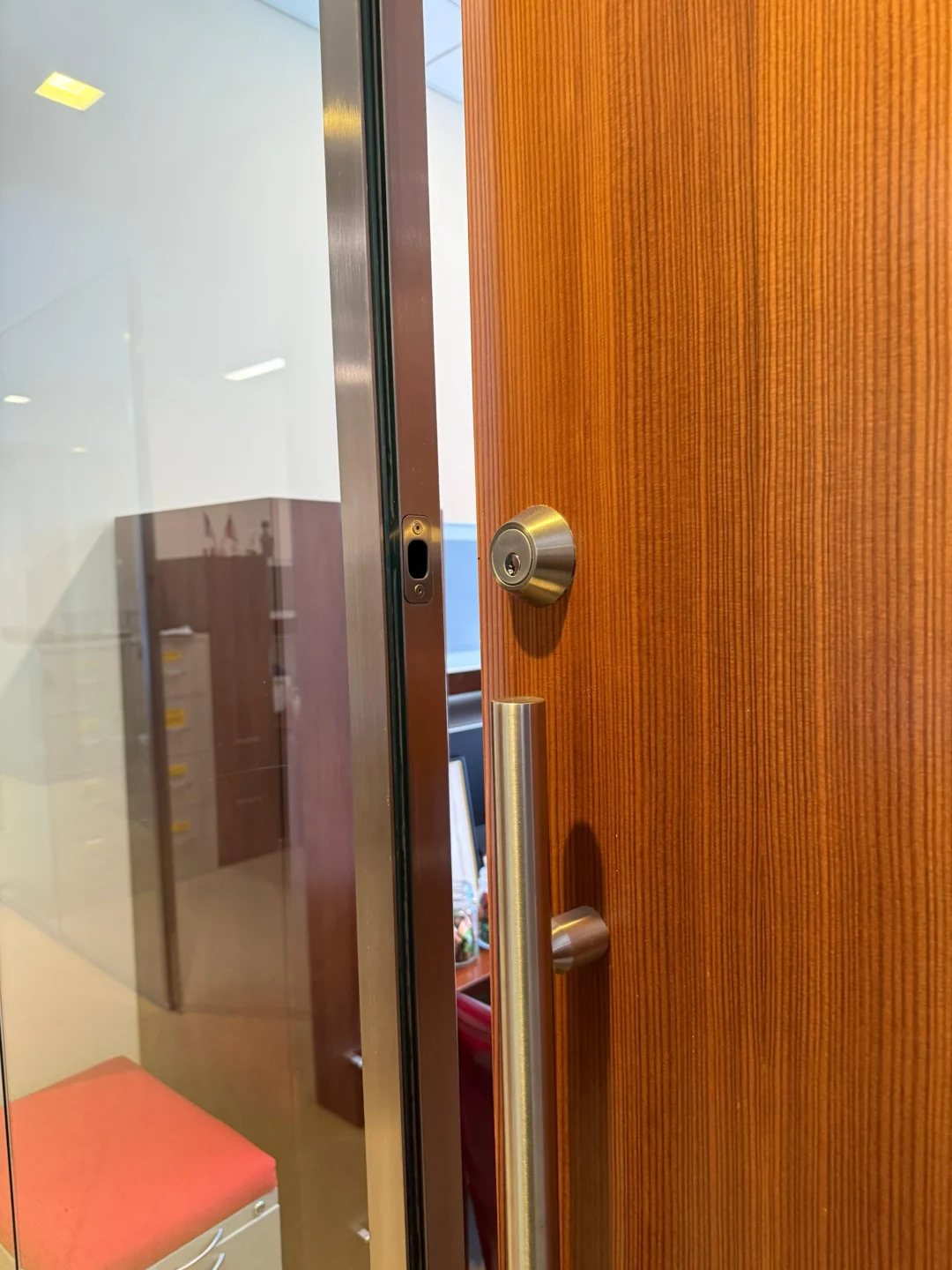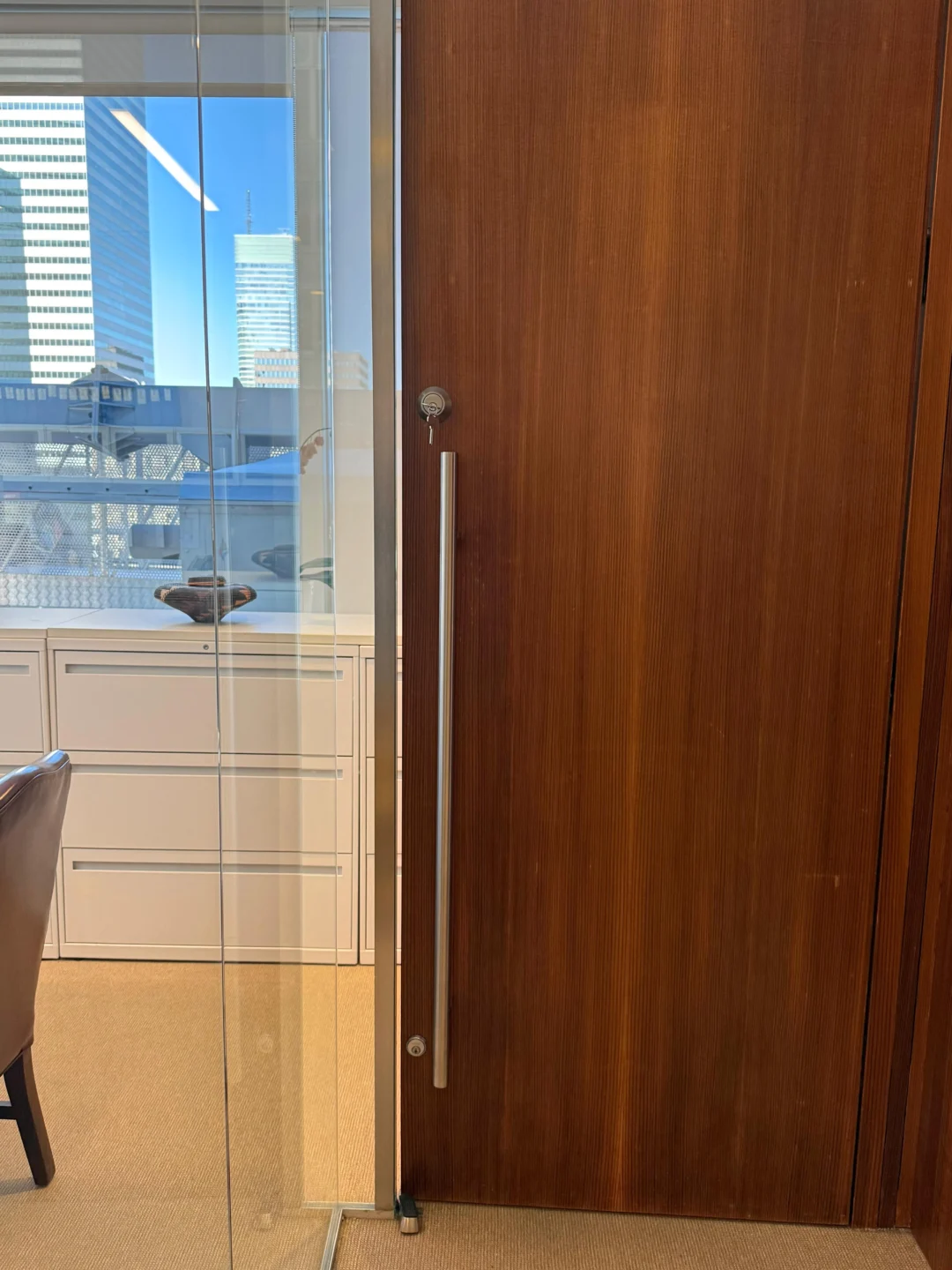
Installing a lock on a glass door starts with a question that most ordinary lock-installation guides never need to ask: what part of this door is actually supposed to hold the lock?
On an aluminum storefront door, the locking mechanism may be installed almost entirely inside the narrow metal stile surrounding the glass. A frameless tempered-glass office door may use a patch lock attached directly to the pane. Another all-glass door may already have a factory cutout for permanent locking hardware, while a no-fabrication lock may simply slip over the glass edge. Those are completely different installations.
The distinction becomes critical because toughened or tempered glass should not be treated like a wood or metal door that can simply be drilled when the new lock does not fit. Pilkington’s technical guidance states that toughened glass should not be cut, drilled, sawed, or edge-worked after toughening because the glass can break or be destroyed. Manufacturers therefore design glass-door hardware around either factory-prepared glass or a no-fabrication mounting system. CRL, for example, sells slip-on patch locks for specific 3/8-inch and 1/2-inch monolithic tempered-glass doors that require no glass fabrication. It separately sells permanent patch locks that require a defined glass cutout.
The correct approach is therefore: identify the door, identify the glass, identify the existing preparation, then choose hardware designed for that exact configuration. For property owners who need help with the entire door rather than only the cylinder, Rainbow Locksmith NY provides dedicated glass door services and storefront door services.
First identify whether the door is frameless tempered glass, an aluminum storefront, framed glass, sliding glass, or a paired-glass entrance. Check the glass thickness and any existing factory cutouts before choosing hardware. Frameless glass may use a compatible no-fabrication slip-on lock or a patch lock designed for existing glass preparation, while aluminum storefront locks are commonly installed inside the metal stile. Do not drill or cut an existing tempered-glass panel to make a new lock fit. After installation, test the lock, keeper alignment, door movement, and any required exit operation.
“Glass door” can mean five very different doors
Before shopping for a lock, identify which type of door you actually have.
Frameless tempered-glass swing door
This is the door most people picture when they search for a frameless glass lock. The door leaf is largely or entirely glass, with patch fittings, pivots, handles, and other hardware attached to prepared areas of the pane. Dormakaba currently lists several lock options specifically for all-glass doors, including bottom locking patch fittings, locking ladder pulls, European-style glass locksets, and heavy-duty glass locksets.
A frameless door does not automatically mean that a new lock can be placed anywhere on the pane. The chosen hardware still has to match the glass thickness, existing cutouts, door gap, keeper location, swing arrangement, and manufacturer requirements.
Aluminum storefront glass door
A typical NYC storefront entrance can contain a large glass panel while the actual lock is installed in the aluminum surrounding it. Adams Rite’s MS1850S deadlock is specifically designed for narrow-stile aluminum storefront doors. Its related MS1850SN version uses a different faceplate and mounting arrangement for wood or hollow-metal doors.
That means an “aluminum glass door lock” project is often really a commercial aluminum-door hardware project, not a glass-fabrication project. Rainbow Locksmith NY’s commercial locksmith services include commercial lock installation and repair, high-security systems, access-control work, and storefront-related service.
Framed residential door with a large glass panel
French doors, patio doors, decorative entry doors, and some apartment doors contain substantial glass but still have wood, fiberglass, steel, or aluminum structure around the panel. In these doors, the lock is usually installed into the structural stile rather than through the glazing. A standard deadbolt may be possible if the door construction and manufacturer preparation support one, but the distance between the lock bore and glass still matters. Do not assume a wide-looking decorative stile contains enough structural material for any lock configuration.
Sliding glass door
A sliding glass door uses a different locking geometry from a swinging glass entrance. The lock commonly engages laterally with the jamb or adjacent panel rather than projecting like a conventional swinging-door deadbolt. A patch lock designed for a frameless swing door should not be adapted to a sliding door simply because both doors contain tempered glass. Rainbow Locksmith NY lists sliding doors separately from swinging and glass doors in its door-service navigation, reflecting the fact that these are different hardware applications.
Double frameless glass doors
Paired glass doors introduce another variable: what receives the bolt? A lock mounted on one leaf may engage:
- A keeper on the other glass leaf
- A floor socket
- The header
- The jamb
- Fixed sidelite hardware
Dormakaba lists bottom patch locks and locking ladder pulls that can secure all-glass doors at the floor or, in some configurations, at the header. CRL likewise manufactures glass-mounted patch locks and keepers intended for defined paired-glass configurations. You therefore need to understand both leaves of a double door before choosing the lock.
The most important rule: do not field-drill tempered glass for a new lock
This is the point where reliable manufacturer guidance differs sharply from some generic DIY content. If an existing tempered glass panel does not have the hole or cutout required by your chosen permanent lock, do not try to create that opening after the glass has been tempered. Pilkington explicitly states that toughened glass should not be cut, sawed, drilled, or edge-worked after toughening. NYC’s 2022 Building Code also requires each pane of tempered glass to be permanently identified by the manufacturer, making that corner marking useful when identifying existing glazing.
If your glass is already tempered and lacks the necessary preparation, the practical options are usually:
- Choose compatible no-fabrication hardware.
- Reuse existing factory cutouts with matching hardware.
- Replace the glass with a panel fabricated for the intended hardware before tempering.
- Have the door system evaluated by a glazing and door-hardware professional.
Drilling a new hole into installed tempered glass because a purchased lock requires one. The lock should adapt to the safe glass configuration, not the other way around.
How to tell whether the existing glass was prepared for a lock
Look carefully around the current hardware. Permanent patch systems can use factory-created holes, notches, or U-shaped cutouts. CRL’s European EUR Series glass-mounted patch lock, for example, is specified for 3/8-inch or 1/2-inch monolithic tempered glass and explicitly requires one glass cutout. The assembly includes gaskets, the lock mechanism, cylinder, covers, keeper, template, and instructions.
That gives you an important replacement rule: existing cutouts are part of the lock specification. Do not purchase another patch lock simply because its exterior dimensions look close. Compare:
- Glass cutout shape
- Cutout dimensions
- Glass thickness
- Hardware orientation
- Keeper position
- Door gap
- Cylinder location
- Lock handing where applicable
Replacing hardware around an existing glass cutout is very different from creating a new installation.
No-fabrication locks: the best option when the glass has no cutout
Some frameless glass doors can accept a lock without permanent glass fabrication. CRL’s Deluxe Patch Lock is one example. Current versions are available for 3/8-inch and 1/2-inch monolithic tempered glass and are designed to slip over the glass edge without requiring glass fabrication. CRL also specifies a recommended 3/16-inch gap between panels for these models.
This category is especially useful when:
- The existing pane has no lock cutout.
- The door gap is compatible.
- The glass thickness matches.
- Only keyed access from one side is required by the selected product.
- The door configuration allows the lock and keeper to align.
“No fabrication required,” however, does not mean “no compatibility check required.” A lock sized for 3/8-inch glass should not simply be tightened harder onto a 1/2-inch pane or vice versa.
Before installing any glass-mounted lock, measure these four things
A frameless glass lock has far fewer opportunities for adjustment after you choose the wrong hardware.
Glass thickness
Measure the pane thickness at an exposed edge where practical. CRL’s current slip-on products distinguish between hardware for 3/8-inch and 1/2-inch glass. Permanent patch systems can also have defined thickness ranges and corresponding gasket configurations.
Door gap
Measure the space between the closing edge of the door and whatever the bolt or lock will engage. On paired frameless panels, this may be the gap between two pieces of glass. On the CRL Deluxe Patch Lock cited above, the manufacturer specifies a recommended 3/16-inch gap. Do not assume your existing door gap is automatically suitable.
Keeper location
Identify exactly where the lock bolt will go. Possible receiving points include:
- A fixed glass sidelite
- The second door leaf
- The wall jamb
- The floor
- The header
- The aluminum frame
The keeper must be compatible with the selected lock.
Door movement
Open and close the door several times before adding hardware. Watch for:
- Door dragging
- Uneven gap
- Door drifting open
- Door not returning to center
- Door slamming
- Existing hardware rubbing
- Pivot movement
A lock should secure a correctly positioned glass door. It should not be used to hold a badly aligned door where it belongs.
Installing a slip-on lock on compatible frameless glass
A no-fabrication lock is one of the few glass-lock situations where installation may be relatively straightforward because no new glass opening is created. The exact procedure must follow the selected manufacturer’s instructions, but the installation logic is consistent.
Start with a clean, stable door
The glass edge and mounting area should be clean, and the door should be stable in its normal operating position. Do not begin by using the new lock to compensate for a door that hangs at an angle or moves unpredictably.
Confirm the glass thickness again
Check the product label against the actual pane. CRL sells separate Deluxe Patch Lock models for 3/8-inch and 1/2-inch glass. If the lock does not correspond to the pane, stop before assembly.
Install every supplied pad or gasket
Glass-mounted hardware often uses gaskets or protective inserts between the metal lock body and glass. These components are part of the hardware design, not disposable packing material. NYC’s Building Code also recognizes the importance of preventing inappropriate glass-to-metal contact, stating that gaskets, washers, shims, seals, or spacers are to be used where required in glazing support systems. Use the components and orientation specified by the lock manufacturer.
Position the lock before final tightening
Place the lock over the glass edge and align it with the keeper. Do not fully tighten one side while the assembly is still being positioned. First make sure:
- The lock is level.
- The bolt lines up.
- The hardware clears adjacent panels.
- The door can move normally.
- The keeper is correctly positioned.
Tighten evenly, not aggressively
Glass hardware needs to be secure, but more torque is not automatically safer. The goal is manufacturer-specified clamping with the correct gasket and glass thickness. If the lock slips even though the correct hardware and supplied contact materials are being used, investigate compatibility instead of continuing to tighten harder.
Test before relying on the lock
Operate the lock several times while watching the bolt. Then close the door and confirm that engagement happens naturally. The glass should not need to be pushed sideways for the lock to meet its keeper.
Installing a permanent patch lock on pre-prepared glass
This is a fundamentally different job from slip-on hardware. A permanent patch lock may be appropriate when the glass was already manufactured with the required cutout. CRL’s EUR Series example uses a defined cutout and is intended for 3/8-inch or 1/2-inch monolithic tempered glass with the appropriate gaskets. The correct workflow is:
- Identify the existing cutout and glass thickness.
- Match the hardware template to that preparation.
- Confirm the keeper position.
- Install the specified gaskets and fittings.
- Assemble hardware according to the manufacturer’s sequence.
- Align the lock before final tightening.
- Test the bolt and cylinder.
- Test the complete door in operation.
The critical difference is that the glass preparation already exists. If the selected patch lock requires a cutout your tempered panel does not have, stop. That is no longer a simple hardware-installation job.
Aluminum storefront doors: the lock usually goes in the metal, not the glass
This is the section that many glass-door articles miss. Walk down a typical NYC commercial block and you will see countless doors made mostly of glass with narrow aluminum rails and stiles. The locking mechanism on these entrances is usually associated with the aluminum door construction. Adams Rite’s MS1850S deadlock, for example, is specifically designed for narrow-stile aluminum storefront doors and uses a different faceplate arrangement from the version designed for wood and hollow-metal applications.
That means replacing or installing the lock involves questions such as:
- Existing stile preparation
- Backset
- Faceplate size
- Mortise cylinder
- Cylinder cam
- Interior thumb turn or lever
- Strike configuration
- Single vs. paired doors
- Existing access-control hardware
Those are commercial locksmith measurements, not glass-drilling measurements. Rainbow Locksmith NY’s commercial locksmith service specifically includes commercial lock installation and repair, access control, master-key systems, and other business-security hardware.
How to recognize an Adams Rite-type storefront lock
Look at the narrow edge of the aluminum door. A narrow rectangular faceplate with a projecting deadbolt or deadlatch mechanism may indicate Adams Rite or similar narrow-stile hardware. Do not identify it only from the cylinder visible on the outside. Adams Rite’s current documentation distinguishes several related hardware families and specifies that the MS1850S is designed for aluminum storefront doors. It also notes that the lock body does not automatically include the mortise cylinder and that an appropriate mortise cylinder with an MS cam operates the lock. So if a storefront cylinder needs replacement, verify the lock body and cam compatibility rather than ordering by keyway appearance alone.
Paired storefront doors need more than one locking point considered
Double aluminum storefront doors can use an active leaf and an inactive leaf. Adams Rite manufactures cylinder-operated flush bolts specifically for the inactive leaf of paired narrow-stile aluminum doors, and its current documentation describes top and bottom locking arrangements used with MS-series hardware. This matters because a strong lock on the active door is only part of the system if the adjacent leaf is not properly secured. When evaluating paired doors, inspect:
- The active-leaf lock
- The inactive-leaf bolts
- The header
- The threshold
- Door alignment
- The astragal or meeting stile
- Closers and pivots
Do not treat each visible cylinder as an isolated component.
Door alignment comes before lock alignment
A glass-door lock can be perfectly installed and still fail if the door itself has moved. Frameless and storefront glass doors can rely on floor springs, pivots, concealed closers, and other hardware to control their position. Dormakaba notes that improper installation of patch fittings and pivots can lead to glass-door hardware failure, including top-pivot problems. Rainbow Locksmith NY’s door closer services page specifically identifies floor-spring closers as hardware used for frameless glass doors and heavy storefront entrances.
If the door is sagging, drifting, slamming, or failing to return to the correct position, address that problem before repositioning the new lock around the misalignment.
A useful lock test: open door vs. closed door
Operate the lock while the door is open. Does the cylinder turn normally? Does the bolt move through its full travel? Now close the door and test again. If the mechanism becomes difficult only after the door closes, the lock cylinder may be fine. The problem is more likely where the bolt meets the keeper, strike, floor socket, or adjacent door. That is especially important with heavy glass entrances because closer or pivot movement can change alignment without anything being wrong inside the lock.
When the storefront glass door won’t stay aligned
If the lock needs to be adjusted repeatedly, inspect the closer and pivot system. Rainbow Locksmith NY has a dedicated storefront and commercial door closer repair page covering glass and aluminum storefront doors that slam, fail to latch, or drift open. A lock should not be repositioned every few months to follow a door whose closer or pivot is gradually failing. Correct the movement first.
Glass-to-glass locks on double doors
A pair of frameless doors can use a lock attached to one pane and a keeper attached to the other. This arrangement requires precise door spacing. The lock and keeper need to meet when both leaves are resting in their correct positions. If the inactive leaf moves, the keeper moves with it. That makes the stability of the second leaf just as important as the lock itself. Some all-glass systems therefore secure the door at the floor or header instead of relying only on the meeting point between two movable panes. Dormakaba currently lists bottom patch locks and locking ladder pulls among its all-glass locking solutions.
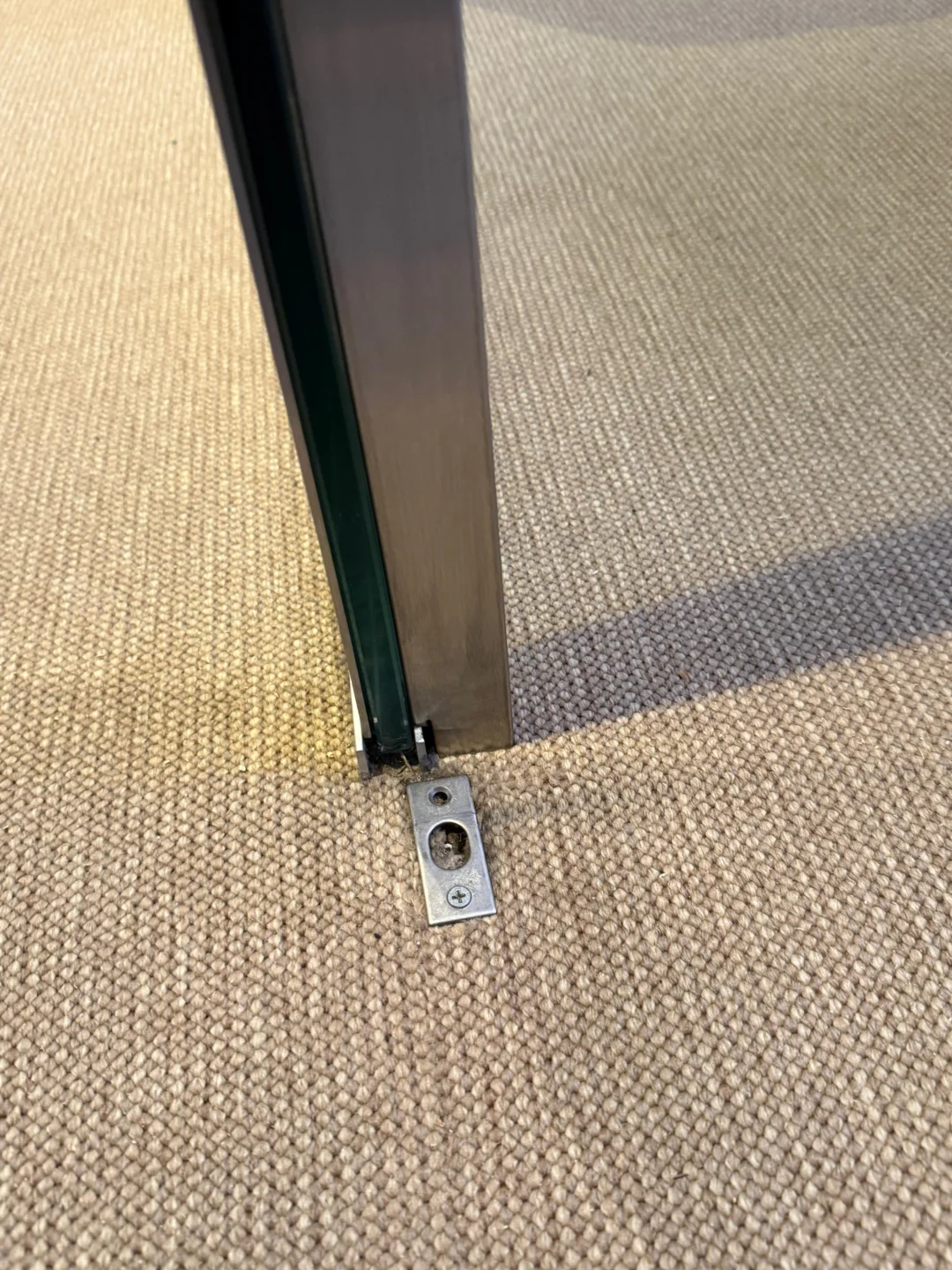
Bottom patch locks and floor engagement
A bottom lock can provide a visually clean solution on an all-glass entrance. Dormakaba describes its UNIVERSAL AR20 bottom locking patch fitting as a common all-glass door option, typically configured with keyed access on one side and a thumb turn on the other, although other cylinder arrangements are available. The installation has to coordinate:
- Glass preparation
- The bottom patch fitting
- The floor receiving point
- The door pivot
- Door clearance
- The lock cylinder configuration
This is not equivalent to adding a conventional floor bolt to an ordinary wood door.
Can you put a smart lock on a glass door?
Sometimes – but not by treating frameless glass like a standard residential deadbolt door. A consumer smart deadbolt typically expects a conventional cylindrical door preparation. Frameless tempered glass usually uses entirely different hardware.
Electronic glass-door solutions do exist. Dormakaba, for example, publishes surface-mount installation guidance for certain electronic locking hardware on glass, including hardware positioned at the glass edge with a corresponding strike. Commercial aluminum storefront doors can also support electrified deadlatches, electric strikes, access-control readers, or other systems when the hardware is designed as part of the complete entrance. Adams Rite notes, for example, that converting an MS1850S deadlock application to access-controlled operation can involve replacing it with a compatible 4900 deadlatch and adding a suitable electric strike and control components. This is much more appropriate than trying to drill a consumer smart deadbolt into tempered glass.
Keypad, card reader, or access control?
For offices and retail properties, a keyed patch lock may not provide the access management the business wants. Electronic access can be useful when the owner needs:
- Employee credentials
- Scheduled access
- Audit capability
- Card or fob entry
- Keypad entry
- Remote release
- Integration with other security systems
But electronic access changes the system design. You need to consider:
- Lock type
- Fail-safe vs. fail-secure behavior
- Door position
- Power
- Egress
- Fire and life-safety requirements
- Existing door preparation
Rainbow Locksmith NY’s commercial locksmith services include access-control work alongside commercial lock installation and high-security systems.
NYC storefront locks and means of egress
A commercial lock is not only a security device. The same door may also serve as part of the building’s required means of egress. The 2022 NYC Fire Code states that required means of egress must remain unobstructed and that door hardware and other egress components must be maintained in good working order. It also states that security devices affecting means of egress are subject to approval requirements. The NYC Building Code separately regulates doors, gates, turnstiles, panic hardware, fire exit hardware, and other components within Chapter 10.
That means a storefront owner should not add a secondary lock simply because it physically fits the glass or aluminum. The occupied-building exit requirements still matter. If the entrance also uses emergency-exit hardware, Rainbow Locksmith NY has a dedicated panic bars and exit devices service page for commercial properties.
Security lock vs. exit hardware: do not confuse the two
A strong after-hours deadlock may be useful for securing a closed business. An exit device serves a different function: allowing occupants to leave appropriately during emergency egress. Some commercial entrances therefore require a hardware strategy that accounts for both security and exit operation. Do not add:
- Auxiliary surface bolts
- Padlocks
- Improvised glass clamps
- Secondary locks
to a required exit without evaluating how the door is intended to function when occupied. NYC’s Fire Code requires egress components to remain in working order and prohibits obstruction of required means of egress.
What if the existing glass door lock is loose?
The correct diagnosis depends on what is moving.
Only the cylinder moves
If the cylinder is loose but the patch or storefront lock body is stable, the problem may be limited to cylinder retention. On aluminum storefront hardware, identify the exact mortise cylinder and lock before removing it.
The entire patch lock moves on the glass
Stop using it as though nothing is wrong. Check:
- Correct glass thickness
- Gaskets
- Mounting components
- Hardware fit
- Manufacturer-specified tightening
- Damage to the fitting
Do not insert random metal shims between the glass and lock.
The glass itself moves in the fitting
That can indicate a more significant glass-door hardware or patch-fitting issue. Have the door system evaluated before continuing to operate or modify the lock.
What if the key is hard to turn?
Test with the door open. If the key is still difficult, investigate:
- The cylinder
- The lock body
- The internal mechanism
- Key condition
If the lock becomes difficult only when the door is closed, inspect:
- Keeper alignment
- Door gap
- The floor socket
- The door closer
- The pivot
- Frame position
Do not replace the cylinder first when the real problem is physical misalignment.
What if the bolt does not reach the keeper?
Do not immediately install a longer bolt or move the lock farther across the glass. First ask why the gap is wrong. Possible causes include:
- Incorrect lock model
- Incorrect keeper
- A shifted door
- Pivot wear
- The wrong glass-to-glass gap
- The wrong mounting location
CRL’s no-fabrication patch locks, for example, specify a recommended 3/16-inch gap for their intended installation. If your actual gap is dramatically different, determine why before modifying the hardware.
What if the glass has the wrong cutout?
This is one of the clearest stop points in the entire guide. If an existing tempered pane has a factory cutout that does not correspond to your intended permanent patch lock, do not enlarge the opening in the field. Pilkington’s guidance against drilling, cutting, sawing, or edge-working toughened glass after tempering applies here directly. Your options are typically to:
- Find hardware matching the existing preparation.
- Use appropriate no-fabrication hardware.
- Replace the glass with properly fabricated glazing.
The lock should adapt to the safe glass configuration – not the other way around.
Glass door lock replacement is usually easier than new installation
A replacement project has one major advantage: the original door already tells you what type of hardware it was designed to accept. Before removing the old lock, record:
- Manufacturer
- Model markings
- Glass thickness
- Cutout shape
- Lock position
- Keeper style
- Cylinder type
- Floor or header engagement
- Door gap
Photograph the complete assembly. If the original hardware is discontinued, those details provide a much better starting point for finding a compatible replacement than simply searching for “glass door lock.”
Common glass door lock mistakes
The biggest errors are usually caused by treating every glass door the same. Avoid:
- Drilling installed tempered glass
- Buying hardware before identifying the door
- Ignoring glass thickness
- Ignoring factory cutouts
- Mixing unrelated patch locks and keepers
- Overtightening clamp hardware
- Removing manufacturer-supplied gaskets
- Using a residential deadbolt on frameless glass
- Treating aluminum storefront hardware like a wood-door lock
- Moving the lock to follow a sagging door
- Ignoring floor closer or pivot problems
- Adding security hardware that affects required egress
- Assuming all double glass doors use the same keeper arrangement
Each mistake comes from the same underlying problem: choosing the hardware before understanding the door.
When a locksmith is enough – and when you also need a glazier
Some glass-door projects are primarily locksmith work. Examples include:
- Replacing an existing storefront deadlock
- Changing a compatible mortise cylinder
- Replacing a no-fabrication patch lock
- Servicing an existing glass-door lock
- Correcting lock and keeper alignment
- Upgrading compatible commercial hardware
Other projects may require glazing expertise as well, especially when:
- New glass cutouts are required
- The existing pane is damaged
- Replacement glass must be fabricated
- Patch fitting preparation needs to change
- Glass thickness is being changed
Because tempered glass should not be field-drilled after toughening, any project requiring a different permanent cutout can become a glass-fabrication project as well as a locksmith project.
When to call for professional glass door lock service
Professional assessment is especially valuable when:
- The glass type is uncertain
- The glass thickness cannot be confirmed
- The existing cutout does not match the new lock
- Permanent glass fabrication would be required
- The door uses an aluminum storefront lock
- The mortise cylinder or cam is unclear
- The door has shifted on its pivots
- A floor closer is failing
- Double-door locking is involved
- Access control is being added
- The door is a required commercial exit
- The lock and keeper repeatedly lose alignment
- An existing glass fitting is loose
- The door cannot currently be secured
Professional glass door lock installation in NYC
Installing a lock on a glass door is not one procedure. A frameless tempered-glass door may need a slip-on patch lock or a permanent system matched to factory glass preparation. An aluminum storefront glass door may need a narrow-stile deadlock, mortise cylinder, deadlatch, or access-control hardware installed in the metal stile. A double glass entrance may depend on a glass-to-glass keeper, bottom lock, header lock, or coordinated inactive-leaf hardware. And if the door will not stay aligned, the lock may not be the first component that needs attention.
Rainbow Locksmith NY provides commercial locksmith services, glass door services, storefront doors, panic bars and exit devices, high-security lock systems, and storefront glass door closer repair for NYC properties. The safest way to approach any glass-door lock installation is to identify the complete door system before choosing the lock. Do not modify tempered glass to fit the hardware. Choose hardware that fits the glass and door system.
Frequently asked questions
Can you install a lock directly on a frameless glass door?
Yes, when the lock is specifically designed for the glass thickness and door configuration. Some patch locks require factory glass cutouts, while others are designed to slip onto compatible tempered glass without fabrication.
Can you drill a tempered glass door for a lock?
You should not field-drill an already toughened glass panel. Pilkington states that toughened glass should not be drilled, cut, sawed, or edge-worked after toughening because breakage can result.
Can you install a glass door lock without drilling?
Yes, for compatible applications. CRL currently offers slip-on patch locks for specified 3/8-inch and 1/2-inch monolithic tempered glass that require no glass fabrication.
What lock is used on an aluminum storefront door?
Narrow-stile aluminum storefront doors commonly use commercial hardware designed for that construction. Adams Rite’s MS1850S is one current example specifically designed for narrow-stile aluminum storefront doors.
Is a storefront glass door lock installed through the glass?
Often no. On framed aluminum storefront doors, the lock mechanism is commonly installed in the aluminum stile surrounding the glass.
What thickness of glass can a patch lock fit?
It depends on the product. CRL currently offers specific slip-on models for 3/8-inch and 1/2-inch tempered glass, while permanent systems may support specified thickness ranges with matching gaskets.
Can I put a standard deadbolt on frameless glass?
A standard cylindrical residential deadbolt is not designed to be field-drilled into an existing frameless tempered-glass panel. Use lock hardware designed for glass, or a structural frame or stile when the door system provides one.
Why does my glass door lock work open but not closed?
If the lock mechanism works freely until the door closes, the problem is likely related to the lock’s engagement with the keeper, frame, floor socket, or adjacent door rather than the key cylinder alone.
Why does my storefront door keep going out of alignment?
The problem may involve the pivots, floor closer, door position, or other hardware controlling the glass door. Rainbow Locksmith NY’s storefront door closer repair page specifically addresses doors that slam, drift open, or fail to latch.
Can a frameless glass door have a floor lock?
Yes. Dormakaba lists bottom locking patch fittings as one of its common locking options for all-glass doors.
Can double glass doors lock to each other?
Yes, depending on the hardware system. Some locks engage a glass-mounted keeper on the opposite leaf, while other systems lock to the floor or header. The receiving leaf must also remain correctly positioned and secured.
Can you add access control to an aluminum storefront door?
Yes, when compatible commercial hardware is selected for the entrance. Adams Rite documents retrofit paths using deadlatches, electric strikes, readers or switches, and power components for appropriate storefront configurations.
Do NYC storefront locks have to consider exit rules?
Yes. NYC’s Fire Code requires required means of egress to remain unobstructed and door hardware to remain in good working order; security devices affecting means of egress are also regulated.
Get help from Rainbow Locksmith NY
Not sure which lock fits your glass door? Rainbow Locksmith NY identifies, installs, and services glass door and storefront locks across NYC – from frameless patch locks to aluminum storefront hardware and access control.
Rainbow Locksmith NY | 338 E 65th St, New York, NY 10065 | Licensed and insured | NYC DCWP License. Hardware specifications and availability change; confirm compatibility with your exact door, glass, and building requirements before purchasing.